
Darts Betting Tips 2026: Form, Value, Margin and What a Tipster Can Honestly Tell You
 Available in US
Most pages that promise “darts betting tips” hand you a few player names and ask you to act on them. That is the wrong end of the conversation. The match has not been played. Nobody — not a published tipster, not a model, not an exchange trader — has a privileged line on a 501 leg, and the page that pretends otherwise is selling something it cannot deliver. What a tipster can honestly pass on is the *method*: how form is read, how a price becomes “value” once the bookmaker’s margin is taken out, how staking and bankroll discipline keep a losing run survivable, and how the British regulatory frame shapes everything from the size of a bonus to what happens when a customer wants to stop. That is what follows.

*Current as of 30 October 2026 — facts cross-checked against the UK Gambling Commission’s public register of remote operating licences.*
The Landscape of Darts Betting in 2026
The phrase “darts betting” covers something wider than the World Championship final. Each winter the PDC World Championship takes over Alexandra Palace with 128 players and a £5,000,000 prize fund — the 2026 edition ran from 11 December 2025 to 3 January 2026, and Luke Littler beat Gian van Veen 7–1 in the final — but the calendar around it is just as crowded. Premier League Darts tours arenas from February to May. The World Matchplay, the Grand Slam, the Players Championship Finals and the European Championship fill the spring and autumn. On any given weekend between January and December there is somewhere a televised nine-darter is possible, and somewhere a bookmaker is pricing it.
UK-licensed bookmakers take darts as a matter of course. The market depth is shallow compared with football or horse racing — the typical Premier League card carries perhaps forty pre-match match lines plus a handful of outright and tournament markets — but every licensed site on the British register offers darts in some form, and the live schedule during a Premier League evening produces several hundred in-running prices across the outright tournament, individual match, next-leg, 180s, highest checkout and a handful of player specials. The shallow depth is itself useful: with fewer prices to watch, it is easier to spot one that has drifted out of line with the underlying probability.
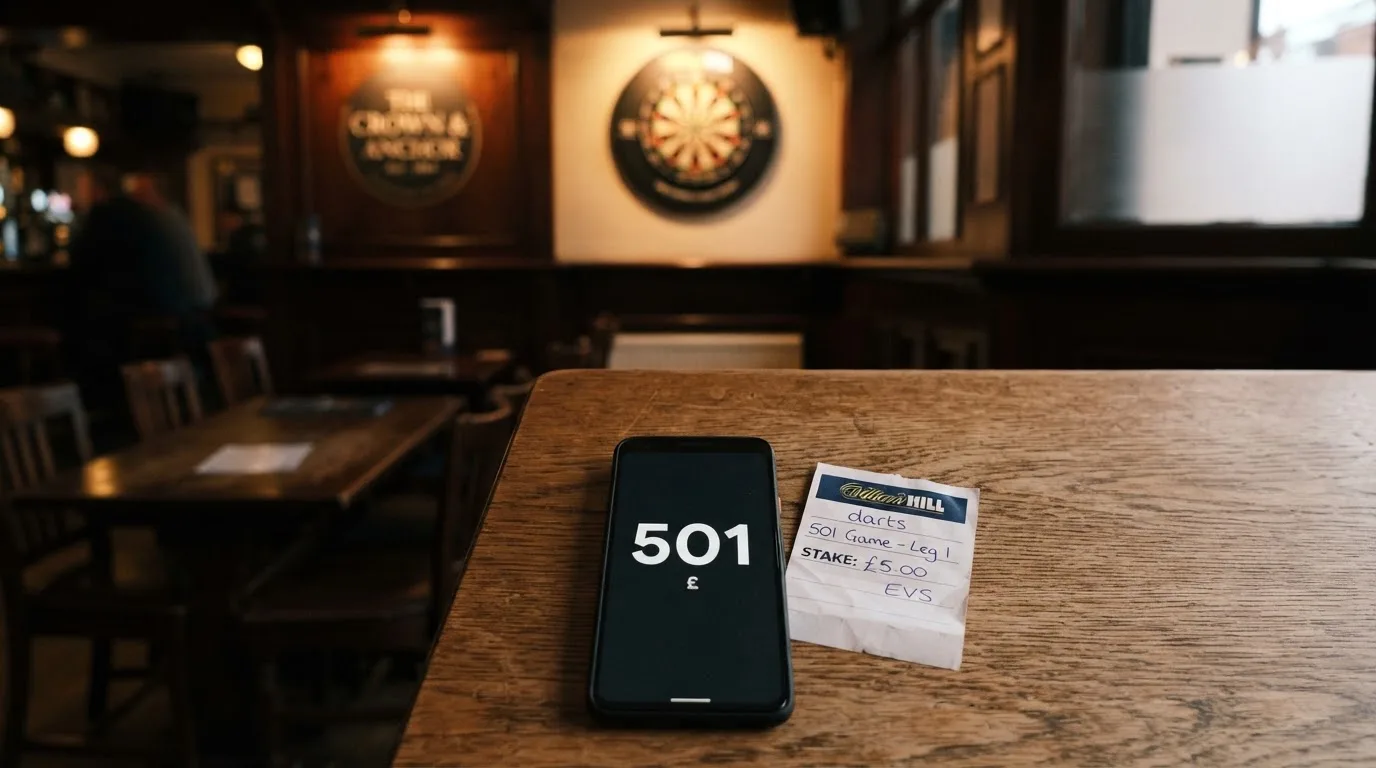
That liquidity is uneven. The PDC World Championship, the Premier League and the World Matchplay trade heavily through the televised sessions; a Players Championship event at Wigan or a Challenge Tour weekend in Coventry moves less money and attracts fewer wagering markets — sometimes only the outright winner, sometimes also a single match winner line. If a method is built around watching the order book, the second tier of events is where a real edge lives, because fewer eyes are on it. If the method is built around reading price moves, the opposite is true.
The teams bettors face, however, are not evenly matched at all. Darts markets attract the same offer vocabulary as any other sport: a “free bet” attached to a £10 stake at minimum odds, a “100% deposit bonus” with a turnover condition, a “best odds guaranteed” line on a market that already pays more in running. The mechanical content of those offers is covered in the bonus section below. The point for this paragraph is only that the landscape has two layers — the tournaments and the offer shelf around them — and a working method has to handle both.
What a “Darts Betting Tip” Actually Means
A tip is a claim that a price is wrong. The claim carries three parts: a probability the tipster estimates for an outcome, a price the bookmaker is offering, and a comparison between them. If the tipster’s probability is higher than the one the bookmaker’s price implies, the difference is the “edge”. A flat-stake £10 wager gains, on average, the edge on every bet — so the discipline of estimating probability is what a tip actually is, not the name of a player.
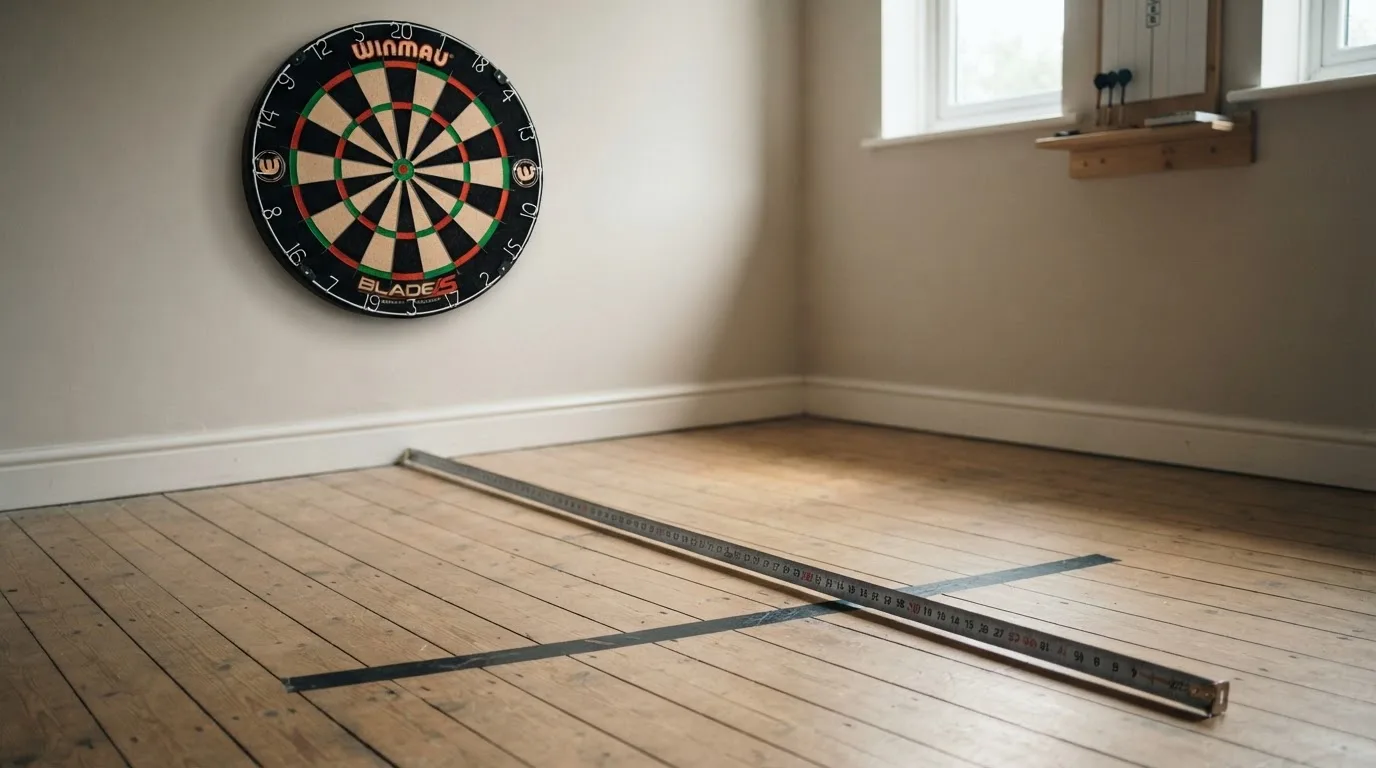
Three things follow. First, the size of the edge matters more than the size of the stake. A 5% edge with a £5 stake makes more per unit staked than a 1% edge with a £500 stake, because both are betting the same proportion of bank but the higher-edge bet wins more often than it loses at a fairer price. Second, the edge is rarely visible. It appears across a sequence of bets, not on a single weekend. Third, the tipster’s estimate can be wrong, and a £10 stake on a “value” bet can still lose; the method is statistical, the result on any single match is binary.
What a tip is not is a guarantee. It is not a name of a player who will win. It is not a system that wins more often than it loses by virtue of having been sold. It is not, importantly, a way of making a living: General Betting Duty is paid by the operator in Great Britain and the player pays no tax on winnings, but a sequence of bets at a 4–6% margin with a 5% edge and natural losing runs of seven or eight losing wagers in a row is a wage, not an investment, and the variance eats a wage that was never there.
Reading Form, Statistics and the Market’s Own Odds
A darts match is short and brittle. A tennis match is a hundred-and-fifty-point contest in which momentum ebbs and flows; a darts leg is the next three throws, then the next, then the next, with no clock to manage and no opponent to serve against. Form — the recent-run component — is therefore unusually heavy as a signal. A player averaging 100.5 in his last ten televised sessions and 102.4 across the year is in form; the same player averaging 96 in his last ten is not, even if his career standard is 99.
The obvious statistics are well-known. Three-dart average, checkout percentage, 180s per leg, percentage of legs won on throw (a “hold”), first-nine-dart average. They are published by the PDC and by specialist sites, and a serious tip logs them across an opponent’s last 10 to 15 matches rather than the career record, because a player’s level moves season to season and the men who reach the Alexandra Palace quarter-finals in January are usually not the men who reached the televised final eight months earlier. The less obvious statistics sit one level down: the percentage of legs a player takes on the opponent’s throw (a “break” in darts terminology, rarer than in tennis), the average checkout taken (the difference between a player who goes 60-60-60 to finish 170 and one who goes for a single 20 then a treble is the difference between an average of 104 and an average of 99).
Line-ups matter too, and here darts is unusual: there is no transfer window, no injury list, no late fitness test. The field for a Premier League night is announced a week in advance and rarely changes. What changes is the order of play — who throws first in a match, who is in the late game against whom — and that matters, because the late game on a Premier League night at a full Ally Pally carries a crowd that has been drinking for two hours and a players’ walk-on that takes three minutes longer than a mid-session match. A player who averages 99 on a Thursday afternoon in Wigan and 103 on a Friday night in Leeds is showing an effect, not a quirk.
The market’s own prices are the third leg of the estimate. A bookmaker at 3/1 about Player A and 1/3 about Player B implies a probability near 25% for A and 75% for B; before adding the margin, the true probabilities are closer to 24% and 73%. If a tipster’s own estimate gives Player A 28% on the recent form and against the head-to-head, the price of 3/1 is “value” in the strict sense: more than the price implies. The estimate and the comparison is what the method does. The pick is the consequence of doing it honestly.
Staking, Bankroll and Surviving Losing Runs
Staking is the second leg of the method and the one that wins or loses the punter over a six-month window rather than a single match. The professional stake-sizing rule, popularised by Kelly and refined for betting markets, says stake as a proportion of bank should equal the edge divided by the price minus one. A 5% edge at 4/1 (decimal 5.00) puts 5/400, or 1.25%, of bank on the bet. A 5% edge at 1/2 (decimal 1.50) puts 5/50, or 10%, of bank on the bet. The full Kelly is mathematically optimal but ruinously aggressive for a recreational tipster; a half-Kelly or quarter-Kelly is the usual compromise, because it loses 25% of the long-run growth but cuts the bankroll variance by half.
Bankroll discipline matters more than picking. A punt with a flat 1% of bank on every bet will survive a 12-bet losing run and stay solvent through a 20-bet one; the same punter staking 5% of bank on a “feeling” will be down half their bank by bet ten. The point is not that flat staking beats Kelly in expectation — it does not — but that a punter who loses 50% of bank on a six-session bad run rarely comes back, regardless of whether the picks were right in expectation. The bankroll is the budget, and the budget is what keeps the method in play long enough for the edge to appear.
A working rule of thumb: decide the unit — say £10, or 1% of bank, whichever is smaller — and stake that unit on every bet at minimum odds of about 6/4 (decimal 2.50) where the estimate shows an edge. Track bets in a spreadsheet by closing price, not by the price seen, because a punter who took 4/1 against a closing 7/2 has a worse price, and a worse price, and a worse-price bet. The spreadsheet will not be much to look at after six months; that is what an honest record looks like.
A second rule of thumb is harder and more important: stop when the bank is at a fixed drawdown. A punter who commits to stop at, say, 25% below the starting bank is exposed to one further bad run, then stops, then reassesses. A punter who keeps going “until it comes good” usually does not stop at all.
Bonuses and Free Bets in Darts Markets
The offers on the shelf around a darts fixture look like generosity until the small print is read. They are not small for the operator; they are the price of acquiring a customer, and the customer pays it back in expected loss across the turnover the offer requires. The arithmetic is what follows.
A “free bet” is the offer the punter meets first. The terms are a £10 fixed-odds free bet on settlement of a £10 qualifying bet at minimum odds — usually 1/2 (decimal 1.50) or evens (decimal 2.00). The stake of the free bet is *not* returned with a win on most UK-licensed sites; only the profit is paid. A £10 free bet at 4/1 (decimal 5.00) returns £40 in profit, not £50. The expected value of that bet depends on the price and on the margin of the market it is placed on. The arithmetic in plain language: a free bet at decimal odds *o* placed in a market with payout share *p* is worth *10 × (o − 1) ÷ o × p*. At *o* = 5.00 and *p* = 0.95, the value is *10 × 4 ÷ 5 × 0.95 = £7.60*. A free bet at *o* = 2.00 in the same market is worth *£4.75*. The offer is real money but not as much as £10.
A deposit bonus is heavier. A typical structure is “bet £10 get £30 in free bets” or a 100% match up to £100. The match carry a wagering requirement: the bonus amount, or the bonus plus the deposit, must be turned over a stated number of times at minimum odds before withdrawal. In Great Britain those wagering requirements are capped at 10× the bonus since 19 January 2026 — a £10 bonus at 50×, the old offshore standard, would have required £500 of qualifying bets; under the cap no offer may require more. That cap applies to all GB-licensed operators. Mixed-product promotions (an offer that requires a bet on football to unlock free spins on a slot, say) are banned on the same terms.
The expected cost of clearing a bonus is the turnover the offer requires times the margin of the market the punter wagers through. A £30 bonus with a 5× wagering requirement on sports at minimum odds of 4/5 (decimal 1.80) needs £150 of qualifying bets in a market whose margin is, say, 6.6%. The expected cost is *£150 × 0.066 = £9.90*. The bonus is then worth the bonus minus the expected cost. The punter pays, on average, a third of the headline value back through the margin. Offer terms move offers into or out of “value” depending on the market the punter chooses to clear through.
Three things a punter should do before claiming any offer. Read the minimum price — a £30 bonus at minimum odds of 5/1 (decimal 6.00) is a different risk profile from the same bonus at 1/2 (decimal 1.50). Read the qualifying-bet rule — many bonuses void the qualifying bet if it is cashed out early, and many void the bonus if a multi-leg acca is placed on the qualifying bet rather than a single. Read the time limit — 7 days, 14 days and 30 days are the usual windows, and an offer that the punter will not actually clear in that window is not an offer worth taking.
A £25 free-bet bundle on a £5+ pre-match qualifying bet at minimum odds of evens (decimal 2.00) within 14 days of sign-up is the kind of headline that appears on a typical GB-licensed welcome page. The window is short. The 7-day expiry on the free bets is shorter. The real value is the calculation above; the headline is what is left after the price and the margin are taken out.
Live Betting, In-Play and Cash Out on a Darts Match
A darts match is ideal for in-play betting: legs settle every three to six minutes, the score is unambiguous, the result is on the screen, and the bookmaker’s traders can reprice in seconds. Premier League evenings move hundreds of markets, from the match outright to “next leg winner” to “next 180” to “highest checkout in the match” to “race to 3 legs” on a player-by-player basis. The half-time equivalent is the mid-session interval; the cash-out equivalent is a settled leg.
A live bet carries a built-in handicap: the bookmaker’s margin is higher in-play than pre-match on most licensed sites, because the pricing update cycle is faster and the firm bears more risk. A 6% margin pre-match on a match outright can rise to 8 or 9% in-play on the same fixture, depending on the operator and the moment. The mathematical effect is to push the implied probabilities of every runner further from the true value, which makes a “value” live bet harder to find. The advantage goes the other way, however, on markets where the live picture is information: if a punter sees a player struggling with a double that has gone 14 for 48 over his last match and against the head-to-head, the live odds on the opponent to win the next leg are, often, slow to update, and the edge is visible for two or three throws before the trader catches it.
Cash out is a settlement, not a bet. A bookmaker offers to buy the punter’s slip back at a price derived from the current state of the match and from the punter’s original odds. The price is unfavourable as a rule, because the bookmaker’s margin on a settled-slip cash out is wider than on the original wager. A punter who cashes out at +£40 on a slip whose true win-or-lose settlement is +£55 is paying £15 of expected value for the certainty; on a 12-run streak of cashing out the punter typically breaks even against the value of letting the bets ride.
Three working rules for in-play. First, the price on a settled leg is the price on a settled leg — the previous leg’s information is already in the next leg’s price, and a punter chasing a “pattern” is chasing the bookmaker’s pattern. Second, cash out is for when the picture has changed and the punter no longer wants the exposure, not for routine settlement. Third, only a small fraction of bank belongs in-play on any one match, because the variance on a 5-leg in-play sequence is much higher than on a single pre-match wager.
Bet Types and Odds — What the Menu Actually Offers
The match outright (Money Line, in some US-derived catalogues) is a two-way market: Player A to win the match, Player B to win the match. The price runs from short (Player A is around 4/9, decimal 1.44, in most televised finals involving the top four) to long (an unseeded qualifier at 100/1, decimal 101.00, in the World Championship). The margin on a match outright is typically tighter than on most football match odds, somewhere between 4 and 7%, because the market is two-way and the information is binary.
Set betting (correct score, in tennis terminology) is the darts equivalent: 7–1, 7–2, 7–3, 7–4, 7–5 in a final to 7, with the two-way markets that follow. The price on a 7–1 final — a Littler or van Veen blowout — is around 6/1 to 8/1 (decimal 7.00 to 9.00) against the top seed depending on the operator; the price on 7–5 is around 4/1 (decimal 5.00). The market is wide and the margin larger; recreational only.
Handicap betting on darts is a points or legs line. A −1.5 leg handicap on a televised Premier League match is the bookmaker giving Player A a one-and-a-half-leg start; backing Player A means A wins by two or more legs in the match. The price depends on the spread and the matchup; in normal play the spread is set to make both sides around 10/11 (decimal 1.91). The market is two-way and the margin around the same range as the outright.
Tournament outrights are the largest pools. The PDC World Championship winner is priced as soon as the field is announced in late November, with the top four in the low single digits and the field thinning down through the 64 winners and 64 seeds. Premier League Darts winner is set the week of the first night in February; the World Matchplay, the Grand Slam and the World Grand Prix follow the same pattern. Margins on outrights are wider than on match odds, because the field is wider and the bookmaker’s job is to balance the book across a hundred prices at once.
A 180s market is darts’ own totals market. A line of 5.5 180s in a leg is a price on whether the total across a single leg is over or under; a line of 13.5 180s in a race-to-3 match is a price on the match as a whole. The market is liquid enough on Premier League nights to be worth watching, less so on a Players Championship afternoon session. Checkout markets — highest checkout of the match, race to a checkout of 100, race to a checkout of 170 — settle on a single event within the match and prices vary widely across operators.
The price format is the British fractional form on most GB-licensed sites: 5/1 reads “five to one”, 11/4 as “eleven-four”, evens as 1/1. Decimal prices sit beside them as a decimal conversion (5/1 = 6.00, 11/4 = 3.75, evens = 2.00). Some operators allow the punter to switch the display; the underlying calculation is the same, and decimal is the form to use when comparing prices across sites.
The return on a single bet at decimal odds *o* with stake *s* is *s × o*. The net profit, the part the punter actually wins, is *s × (o − 1)*. A £10 bet at decimal odds 5.00 returns £50 (£40 profit); a £10 bet at 1.50 returns £15 (£5 profit). An accumulator is the same calculation with the odds multiplied leg by leg — a three-leg acca at legs of 1.80, 2.50 and 3.00 has combined odds of *1.80 × 2.50 × 3.00 = 13.50*, and a £5 stake returns *£67.50* for a net *£62.50*. Every leg must win; one leg down and the bet loses.
The Top Ten — How the Comparison Reads
The table below lists ten bookmakers who are on the UK Gambling Commission’s public register against a remote general betting licence for Great Britain. The Commission account number and the licence holder are stated. What each operator’s own published terms say about free bets, acca builders, payment methods and a few features of relevance to darts punter is given in the fourth column. Offers are described qualitatively from the operators’ own pages; the comparison is one of *what each site’s terms say about a darts punter*, not a ranking.
| Bookmaker | Licence status | Payment note | Terms of particular relevance to darts |
|---|---|---|---|
| Paddy Power | UKGC account 39439, licence holder PPB Counterparty Services Limited | Standard debit card and e-wallet coverage | Bet Builder+, Popular Bet Builders, Super Sub (a bet rolls to a substitute if a named player is replaced mid-match), Win More markets, player and acca stats across the wider football-led catalogue; darts gets the standard match outright, set betting and tournament winner coverage |
| Betmaster | UKGC account 65699, licence holder BM Solutions GB Ltd | Standard UK-licensed mix | General sportsbook; darts scheduled events and outright tournament markets are supported on a typical card |
| BetGoodwin | UKGC account 2927, licence holder Goodwin Racing Limited | Standard debit card coverage | Best Odds Guaranteed on UK and Irish horse and greyhound racing, up to £1,000, on both single and multiple bets; darts coverage sits around major televised tournaments |
| Sporting Index | UKGC account 27343, licence holder Sporting Index Limited | Standard mix; spread-betting product alongside fixed-odds | £10 fixed-odds bet at minimum odds 1/2 unlocks three £10 fixed-odds free bets plus spread-bet tokens; the qualifying bet cannot be placed in-play or cashed out |
| LiveScore Bet | UKGC account 56859, licence holder LiveScore Betting and Gaming (Gibraltar) Limited | Visa, Mastercard, Apple Pay, PayPal, Open Banking via Pay by Bank, Revolut Pay | Score-driven feed carries live in-running markets for televised darts sessions; standard sportsbook on the match outright and set betting |
| Midnite | UKGC account 101839, licence holder Midnite Limited | Standard debit card and e-wallet mix | £25 free-bet bundle and 50 free spins on a £5+ pre-match qualifying bet at minimum odds evens within 14 days; free bets expire in 7 days; in-play events, acca builder, popular accas, price boosts with maximum-stake limits |
| DAZN Bet | UKGC account 48756, licence holder DZBT Limited | £5 minimum deposit by debit card, Apple Pay, Paysafecard, Trustly and Skrill; £20 by PayPal; no processing fees | Sportsbook framed around televised sport; darts coverage includes Premier League and major PDC tournaments on the standard outright and match markets |
| Lottoland | UKGC account 38991, licence holder EU Lotto Limited | Standard UK-licensed mix | Casino, lottery betting, sports and scratchcards in one app; sports catalogue carries the televised darts calendar alongside the lottery-led core |
| Fitzwilliam Sports | UKGC account 48760, licence holder SBKI Limited | Standard mix | Phone and live chat cover, office open 09:00 to 21:00 Monday to Sunday, messenger replies within roughly 90 seconds; sportsbook carried on the standard match and outright darts markets |
| William Hill | UKGC account 39225, licence holder WHG (International) Limited | Standard UK-licensed mix | Best Odds Guaranteed on UK and Irish horse racing from 8 AM on the day of the race, on both single and multiple bets; no application to ante-post, tote or pari-mutuel bets; darts takes the standard match outright, set betting and tournament winner catalogue |
A note on the licence column. The Commission’s public register lists every operator licensed to take remote bets from customers in Great Britain, and the register is the test of whether a brand is licensed. There is no “the only licensed brand”: there are around two hundred licensed operators on the register at the time of writing. Comparison of ten of them does not narrow the field. The punter verifies the licence directly against the register before staking, particularly if the brand is one the punter has not used before.
The brand write-ups that follow cover the same ten names in the same order. Each is judged on the basis of the operator’s own terms and the Commission’s register, on the player-facing material research was able to verify, and on what a punter comparing options for darts markets actually sees when opening an account.
Paddy Power — A Familiar Catalogue with an Acca Tilt
Paddy Power’s UK sportsbook carries the standard televised darts calendar: the PDC World Championship, the Premier League, the World Matchplay, the Grand Slam and a handful of Players Championship events. The brand’s distinguishing features are around the bet construction rather than the darts depth: Bet Builder+, a stack of popular pre-built accas across the catalogue, the Super Sub rule that rolls a named-player bet to a substitute if the player is replaced mid-match, and a Win More expansion of the match-outright vocabulary. Player and acca stats sit alongside the betting slip. For a punter who runs a series of same-game acca bets through the Premier League nights and wants the slate handed back as a built product, this is the surface that does the work; for a single-match-outright wagerer the darts depth is comparable to any other licensed brand on the table.
The verdict: Paddy Power is the better pick for a same-game-multi punter who values the Bet Builder+ catalogue and the Super Sub insurance; it is not different from a typical licensed sportsbook on a single match wager.
Betmaster — A Standard UK-Licensed Sportsbook
Betmaster carries a UKGC remote licence under BM Solutions GB Ltd, registered in Malta. The catalogue is a general sportsbook, with darts scheduled events and outright tournament markets on the typical card. There is no published darts-specific feature set distinct from the standard match and outright line. For a punter who uses Betmaster as a second-book line, the darts coverage is straightforward and the conditions standard.
The verdict: Betmaster is a competent second book rather than a specialist darts shop — useful on a Player A line the punter wants to compare against a second quote, unremarkable on its own.
BetGoodwin — A Racing-First Book That Took Darts Along
BetGoodwin’s published distinctive is Best Odds Guaranteed on UK and Irish horse and greyhound racing up to £1,000, applied to single and multiple bets. The brand is owned by Goodwin Racing Limited, an established on-course bookmaker whose online book inherited the racing tilt. Darts coverage is present on the standard match outright and tournament markets around the major televised events, but the racing frame is what the betting conditions are written for. For a punter whose betting is mostly racing with an occasional darts weekend the conditions cross over cleanly; for a darts-only punter the racing-led terms do nothing for the wallet.
The verdict: BetGoodwin is the right choice if the punter’s betting calendar is racing-led and darts is a few bets a season; for a daily darts punter the conditions are not the reason to choose it.
Sporting Index — A Mixed Fixed-Odds and Spread-Betting Site
Sporting Index carries the UKGC remote licence under Sporting Index Limited, with a fixed-odds sportsbook alongside its spread-betting product. The new-customer offer is £10 fixed-odds free bets unlocked by a £10 qualifying fixed-odds bet at minimum odds of 1/2 (decimal 1.50), plus three £5 Total Goals spread bets, three £5 Winning Favourites spread bets and a £1 Race Index spread bet, with the qualifiying bet excluded from in-play or early cash-out settlement. The mix is unusual for a UK sportsbook and reflects the brand’s spread-betting heritage. Spread betting is a different product class from fixed-odds: losses can exceed the deposit, and it is regulated by the FCA as well as by the Gambling Commission. A punter who has not opened a spread-bet account before should read the FCA’s spread-betting risk warning on Sporting Index’s site before staking anything on the spread-bet leg of the offer.
The verdict: Sporting Index is for a punter who wants both a fixed-odds sportsbook and a spread-betting counter — the free-bet bundle is wide; the spread-bet leg is a different risk and needs separate reading. Pure fixed-odds punters will see more straightforward free bets elsewhere.
LiveScore Bet — A Score-First In-Running Book
LiveScore Bet’s product is built around the score feed: live in-running markets for televised darts sessions sit inside the same interface as the app’s headline scores service. The payment set covers Visa, Mastercard, Apple Pay, PayPal, Open Banking via Pay by Bank and Revolut Pay. Darts depth on televised nights covers the match outright, the next-leg winner and a handful of player specials. For a punter who watches the session through the LiveScore app and wants to click through to a price on the next leg, the surface is fast; for a punter who opens the sportsbook page first and searches for a price, the experience is no different from a standard licensed brand.
The verdict: LiveScore Bet is the cleaner pick when the punter is already in the LiveScore app for the score feed; the darts catalogue itself is standard.
Midnite — A Modern Catalogue with Tight Free-Bet Rules
Midnite’s UK site carries the UKGC remote licence under Midnite Limited and runs a sportsbook with in-play, acca builder, popular accas and price boosts with maximum-stake limits. The welcome offer is £25 in free bets and 50 free spins on a £5+ pre-match qualifying bet at minimum odds of evens (decimal 2.00) within 14 days of sign-up, with the free bets expiring in 7 days. The 14-day window for the qualifying bet and the 7-day window on the free bets are tight; the minimum odds are ordinary. The maximum-stake limits on price boosts are the part a frequent punter should check before betting — boost prices often look generous at small stakes and compress hard past a stated ceiling. The brand positions itself as a younger-facing site than the legacy sportsbooks on the table, and the interface confirms that.
The verdict: Midnite is for a punter who values an acca-builder-led experience and has read the price-boost stake limits; the welcome free-bet window is tight and the experience post-welcome depends on the punter’s stake pattern.
DAZN Bet — A Broadcast-Brand Sportsbook with Sportsbook Norms
DAZN Bet’s UK site is a sportsbook built around the broadcast business of its parent, with a £5 minimum deposit by debit card, Apple Pay, Paysafecard, Trustly and Skrill, and a £20 minimum by PayPal, no processing fees. The catalogue covers Premier League darts and the major PDC tournaments on the match outright and set betting, with in-play on the televised nights. There is no darts-specific feature set distinct from the standard sportsbook on the table. The £5 minimum deposit is helpful for a punter who wants a low entry; the catalogue is otherwise comparable to the rest of the licensed field.
The verdict: DAZN Bet is a competent televised-sport book with a low entry deposit; it does not stand out on darts and does not stand behind on darts either.
Lottoland — A Lottery-Led Catalogue with a Sports Arm
Lottoland’s UK operation carries a UK Gambling Commission licence for Great Britain and runs casino, lottery betting, scratchcards and a sports catalogue inside one app. The sports arm covers the televised darts calendar around the major events alongside the lottery-led core; the user interface mixes the four product tabs and the experience is closer to a multi-product site than to a sportsbook-first brand. For a punter whose sports betting is a weekend session inside a wider lottery play, the integration is a feature; for a punter whose sports betting is large relative to the rest of their play, the lottery framing is in the way.
The verdict: Lottoland works for a punter whose betting is multi-product; it is not the right pick for a darts-only punter.
Fitzwilliam Sports — A Sportsbook with a Strong Customer-Service Frame
Fitzwilliam Sports carries the UKGC remote licence under SBKI Limited and runs a sportsbook with phone and live chat cover through an office open 09:00 to 21:00 Monday to Sunday, with messenger replies often within 90 seconds. The catalogue covers the standard match outright, set betting and tournament winner markets across darts. The customer-service frame is the distinguishing feature for a punter who likes a phone line during a session — most licensed sportsbooks now lead with chat only. For a punter who wants a person on the phone at 19:30 on a Saturday, this is rare on the British register; for a punter who uses live chat without preferring a phone line, the rest of the licensed field is comparable.
The verdict: Fitzwilliam Sports is the right pick for a punter who values phone support; the darts catalogue is standard and the choice is about service rather than market depth.
William Hill — A Legacy Catalogue with a Racing Convention
William Hill’s UK site is one of the larger legacy British sportsbooks, with a UKGC remote licence under WHG (International) Limited. The published distinctive is Best Odds Guaranteed on UK and Irish horse racing from 8 AM on the day of the race, on both single and multiple bets, with no application to ante-post, tote or pari-mutuel bets. Darts coverage sits on the standard match outright, set betting and tournament winner catalogue; the racing convention does not cross over to darts. For a punter whose darts and racing betting sit on the same calendar, the racing BOG carries through the rest of the brand; for a darts-only punter the racing terms are background.
The verdict: William Hill is the right pick for a punter who values a long-established British book with a large racing convention behind it; the darts catalogue is comparable to other licensed books and the choice is about the book rather than the market.
The Margin, the Book and What It Costs a Punter
The bookmaker’s margin is the percentage of every unit bet on a market that the firm keeps, on average, regardless of outcome. It is the reason the prices on the same fixture differ from operator to operator, the reason a “value” bet exists in the strict sense, and the reason two punters betting the same stake on the same match at different prices have different expected outcomes.
The arithmetic in plain language. A two-way market with decimal prices *o₁* and *o₂* has payout share *1 ÷ (1/o₁ + 1/o₂)* and margin *1 − payout share*. At decimal odds 1.90 / 1.90 the payout share is *1 ÷ (1/1.90 + 1/1.90) = 1 ÷ 1.0526 = 0.95* — a margin of *5%*. At 1.85 / 1.85 the payout share is *1 ÷ 1.0811 = 0.925*, a margin of *7.5%*. At 1.80 / 1.80 the payout share is *1 ÷ 1.1111 = 0.90*, a margin of *10%*. The same two-way match has, at three different operators, three different margins — and the punter who took the price at the wider margin has paid more per unit bet than the punter who took the price at the tighter margin.
A typical darts match outright on a televised session runs at a 5 to 7% margin across most licensed UK brands; in-play markets on the same fixture run 7 to 10%. Tournament outrights (the winner of the PDC World Championship) run 12 to 20% margin across the field, because the bookmaker is pricing a hundred names at once and balancing against the disparate betting volume on each.
The punter’s job is to compare margins across books and pick the tight one. The bookmaker’s job is to set the market at a margin that recoups promotional cost, customer-acquisition cost, the licence levy and the operating cost of the platform, and still leaves margin. Both jobs are real and the cost is borne by the punter in every wager regardless of outcome. Knowing the margin of the market the punter is betting in is the information that separates a working method from a tip-sheet chase.
Legality — What the British Frame Means
The Gambling Act 2005 covers Great Britain — England, Scotland and Wales; Northern Ireland has its own older law and is not regulated by the Commission. The Commission licenses the whole commercial market. There is no state monopoly. A bookmaker whose remote facilities are used in Great Britain must hold a Commission licence wherever it is based — since the Gambling (Licensing and Advertising) Act 2014, a Curaçao, Maltese or Gibraltar licence is not a substitute. The Commission’s public register can be searched by business name, trading name, domain or account number, and is the test of who holds a licence.
Identity verification happens before the first deposit. A punter opening an account at a licensed brand must verify name, address and date of birth before staking anything, including a free bet or bonus. Verification runs through credit-reference agencies, electoral roll checks, and document upload where necessary. Source-of-funds questions at higher spend are normal under money-laundering rules. There is no anonymous play at a British-licensed site.
A financial vulnerability check applies to licensed remote betting when a customer’s net deposits — deposits minus withdrawals — exceed £150 in a rolling 30 days. The check is a public-record one (bankruptcy or county court judgments), not an income check. Financial risk assessments — the affordability checks of the press — were announced in July 2026 with a staged plan and no start date. Deposit limits at a fixed time frame are part of the LCCP, the first phase since 31 October 2025 and a second phase postponed to 30 September 2026; whether the second phase is live is not established. Help in either case sits with GamCare, the National Gambling Helpline, the NHS gambling clinics and Gamblers Anonymous.
An unlicensed brand runs under its own house rules. A punter who opens an account at an unlicensed site has no Commission complaints route, no approved dispute-resolution body, no GAMSTOP coverage, no British consumer redress if funds are withheld, and is not bound by the British 10× bonus cap or the £150 vulnerability check. The licence makes the difference between a regulator who can investigate and a regulator who cannot.
Responsible Gambling — What the Frame Requires of the Punter
GAMSTOP is a national multi-operator online self-exclusion scheme and a mandatory licence condition for online operators since 31 March 2020. A punter can self-exclude for six months, one year, five years, or five years with auto-renewal; after the minimum period the exclusion stays in place for a further seven years unless the punter asks GAMSTOP to remove it. GAMSTOP covers online sites and apps; betting shops use a separate service. The exclusion is free and the registration is online.
Deposit limits are a separate control. A licensed operator must offer a gross deposit limit on a fixed time frame; the punter sets the limit on a daily, weekly or monthly basis through the account tools. Time-outs and product restrictions — a self-imposed block on a category for a defined period — sit alongside the deposit limit. A punter who wants to stop completely uses GAMSTOP; a punter who wants to set a budget uses the deposit limit; a punter who wants a short break uses a time-out.
The British player pays no tax on betting winnings. The operator pays General Betting Duty at 15% on gross profits, with a staged change to 25% on remote bets from 1 April 2027. Spread betting has its own rates. HMRC is the body a professional gambler would consult, not the Commission.
Frequently Asked Questions
How do you bet on darts?
Open a UK Gambling Commission-licensed account, verify name, address and date of birth before the first deposit, and pick a market from the operator’s darts tab. The typical televised session carries a match outright (who wins the match), set betting (the correct score), 180s markets (over/under on a stated line), checkout markets (race-to-a-checkout or highest checkout of the match), and tournament outrights for the larger events. Stake and settle as on any sports wager; the return on a single bet at decimal odds *o* with stake *s* is *s × o*.
What is darts betting?
It is betting on professional darts fixtures — the PDC’s televised calendar primarily, alongside WDF events and a long tail of Players Championship weekends. Markets cover match outcomes, set scores, totals (180s), checkouts, and the outright winner of a tournament. Darts is a fast, two-way sport with a deep televised calendar and a shallow but liquid sportsbook depth compared with football.
How does darts handicap betting work?
A handicap market gives one player a fictional legs lead or deficit before the match starts. A −1.5 leg handicap on Player A means A begins the match effectively 1.5 legs up; backing A means A must win by two or more legs in reality for the bet to settle. A +1.5 leg handicap on Player B means B begins effectively 1.5 legs up; backing B means B can lose by one leg in reality and still win the bet on the handicap line. Handicaps are stated by the bookmaker to make both sides around 10/11 (decimal 1.91).
What is a value bet and why is no tip ever certain?
A value bet is a wager at a price that exceeds the probability the punter estimates for the outcome. The estimate is built from form, statistics, line-ups and the head-to-head; the price comes from the bookmaker. If the punter’s probability estimate is higher than the price implies, the bet is value. No tip is certain, because the estimate can be wrong and the market is probabilistic: a value bet is a long-run proposition, not a single-event guarantee. Variance on a sequence of bets produces losing runs even when the estimates are right; the method is statistical and the result on any single match is binary.
What is the bookmaker’s margin and how can it be seen in the odds?
The margin is the percentage of every unit bet the bookmaker keeps, on average. For a two-way market at decimal odds *o₁* and *o₂*, the payout share is *1 ÷ (1/o₁ + 1/o₂)* and the margin is *1 − payout share*. The wider the margin, the less the punter wins per unit bet. A typical televised match outright runs 5 to 7% margin; an in-play market on the same fixture runs 7 to 10%. Comparing the margin across books is the punter’s first line of pricing defence.
How is the return on a bet worked out from the stake and the odds?
Return = stake × decimal odds. Net profit = stake × (decimal odds − 1). A £10 stake at decimal 5.00 returns £50 with £40 net profit; a £10 stake at decimal 1.50 returns £15 with £5 net profit. An accumulator is the same calculation with leg odds multiplied: a three-leg acca at 1.80, 2.50 and 3.00 has combined odds of 13.50, and a £5 stake returns £67.50 for a £62.50 profit. Every leg must win; one leg down and the bet loses.
Tennis, darts & cue sports – tenniscourttips.com
Content created by the «tenniscourttips.com» team
