
The Goliath Bet Explained: How 247 Bets Across 8 Selections Actually Work
 Available in US
Current as of 30 October 2026 against the Gambling Commission’s public register.
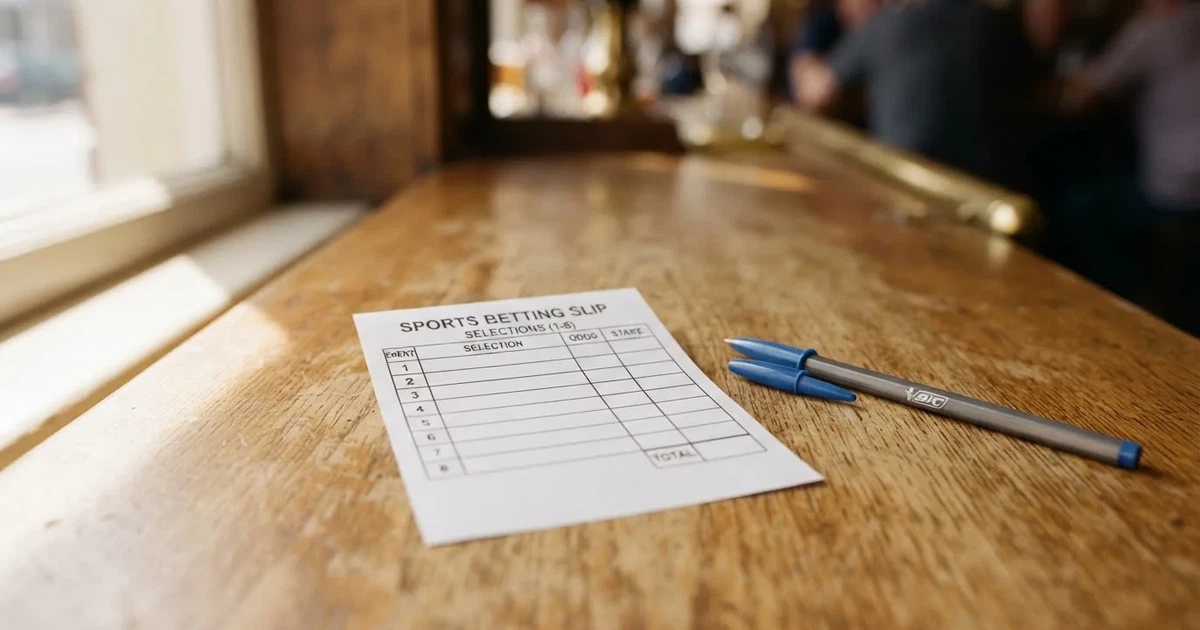
A Goliath is the largest of the standard full cover bets: 247 individual bets stitched together from 8 selections. Every double, every treble, every four-fold, every five-fold, every six-fold, every seven-fold and the single eight-fold accumulator is in there, and nothing else. There are no singles. A punter who picks 8 football matches, 8 horses or 8 tennis matches and asks for a Goliath hands the bookmaker 247 separate wagers built from those 8 picks, and the stake gets multiplied by 247 before the slip is accepted.
That single number, 247, is where the whole cost story starts. A punter who fancies a £2 unit is committing £494 before a ball is kicked, a horse has cantered or a racket has been swung. A punter who likes £5 per line is committing £1,235. The bookmaker takes the £494 or the £1,235 as a single payment, settles each of the 247 lines separately, and pays out only on the ones that win. Lines that lose are gone. There is no “insurance” line inside a Goliath; the structure is the bet.
This matters because search interest in Goliath bets tends to arrive in two flavours. The first is curiosity: how is this thing built, how is it settled, how does a winning line pay. The second is strategy: is there a way to play one that doesn’t burn through the bankroll before the last selection goes in. The angle of this page is the cost — the cash a punter commits, the margin the bookmaker keeps on every line, the gap between “all 8 win” and “7 of 8 win”, and the licence conditions that decide whether the brand taking the bet is one a British customer can hold to account when something goes wrong. The arithmetic is the focus of this guide; the rest is what gives the arithmetic shape.
Why Goliath Betting Strategy Starts With the Stake
The Bankroll Reality of a 247-Line Bet
The standard small-stake punt on a Goliath is £1 per line, which means £247 out of pocket to place the bet. That is a lot to lose on a single slip, and it is what the structure costs before any analysis runs. A punter chasing a life-changing return on a few pounds is not the Goliath’s natural reader; the natural reader is someone who can afford to lose the full stake and is buying the insurance that “a couple of losers doesn’t kill the slip”.
That insurance is real but expensive. A Goliath that lands all 8 selections pays out on all 247 lines. A Goliath that lands 7 of 8 pays out on every line that does not include the one loser, which is 247 minus the number of lines that contained the loser. A Goliath that lands 6 of 8 pays out only on lines drawn from those 6, and the shortfall widens with every missing selection. A Goliath that lands 3 or fewer of the 8 returns nothing at all; the 247 bets that included at least one losing pick all lose.
The strategy pages that sell “Goliath betting systems” tend to skip this arithmetic. They tell the reader that the bet covers every combination of multiples so that one or two losers don’t end the bet, which is true, and they leave out that the price for that cover is a 247-times stake before the first event starts. The strategy is the cover itself. There is no further system: a Goliath is the structure.
What a “Selection” Actually Means
Eight selections is eight individual betting opportunities on separate events. The punt is most often built across 8 different football matches, 8 different horse races or 8 different tennis matches, and the bookmaker treats each as an independent outcome. A bettor who puts two picks from the same match into a Goliath is asking the bookmaker to settle a “double” where one leg is dependent on the other — which most bookmakers either decline or settle at SP (starting price), so the cleaner route is to keep selections to one per event.

Each selection gets its own odds. A Goliath built from eight 2.00 shots multiplies out to a headline accumulator price of 2.00⁸ = 256.00 if all 8 win — the eight-fold leg alone returns 256 × the unit stake — but the punter is also paid on every smaller multiple that doesn’t contain a loser. The total return is the sum of payouts on all 247 winning lines, and the gap between “all 8 win” and “7 of 8 win” is the difference between a Goliath and a much smaller return on a much smaller bet.
Why “Tips” Pages Understate the Cost
The search traffic around “Goliath betting tips” and “Goliath bet strategy” comes from readers looking for selections — which 8 horses, which 8 football matches, which 8 tennis players. The picks themselves are outside what any responsible page can offer, because no one can know an outcome in advance, and a tipster who claims otherwise is selling a fiction. What a Goliath page can do is show what each pick costs once it lands in the structure, and that is the part the strategy pages underplay.
A pick at 2.00 sitting in a Goliath that goes 8 from 8 contributes to a return of 256 × unit stake from the eight-fold leg alone, plus its share of every other multiple. A pick at 5.00 sitting in the same Goliath contributes to an eight-fold return of 5.00⁷ × 2.00 = 312,500 × unit stake, which is the headline number any marketing page leads with. The same pick at 5.00 sitting in a Goliath that goes 7 from 8 — assuming the 5.00 shot is one of the 7 winners — contributes to a seven-fold leg of 5.00⁶ × 2.00 = 62,500 × unit stake, plus its share of the smaller multiples, and the punt loses every combination that included the missing leg.
The cost of a pick is not its single odds. The cost of a pick is the 247 lines that disappear if it loses.
The “Lucky” Comparison
The Lucky 15 (15 bets on 4 selections, including singles), the Lucky 31 (31 bets on 5 selections, including singles) and the Lucky 63 (63 bets on 6 selections, including singles) sit one rung below the Goliath in size and one rung above it in friendliness: they pay out on singles, so one winner returns something. A Goliath does not pay out on singles. A Goliath with only one winner returns the stake on nothing, and that is the single biggest difference between the Lucky family and the full cover family without singles.
The Heinz (57 bets on 6 selections) and the Super Heinz (120 bets on 7 selections) are closer cousins: they are full cover bets without singles, and they share the Goliath’s structure at smaller scale. The Canadian, also called the Super Yankee, is 26 bets on 5 selections and is the smallest full cover bet without singles.
A Goliath is the top of that ladder. It is also the most expensive line on the ladder before the betting starts.
How the Bet Is Built and Settled
The 247 Bets, by Type
The 247 lines in a Goliath break down as follows: 28 doubles (one for each pair of selections), 56 trebles (one for each triple), 70 four-folds (one for each set of four), 56 five-folds, 28 six-folds, 8 seven-folds and 1 eight-fold accumulator. The pattern is symmetric — the number of lines grows to the middle and shrinks back, because the number of ways to choose k items from 8 is largest in the middle of the range.
The maths behind those numbers is the binomial coefficient “8 choose k” for k = 2, 3, 4, 5, 6, 7, 8, and the sum of those coefficients from 2 to 8 is 247. The Trixie (4 bets on 3 selections), the Patent (7 bets on 3 selections, including singles), the Yankee (11 bets on 4 selections), the Canadian or Super Yankee (26 bets on 5 selections), the Heinz (57 bets on 6 selections) and the Super Heinz (120 bets on 7 selections) follow the same construction at smaller scale. The Goliath is the natural extension of that pattern to 8 selections.
Each of the 247 lines settles independently. A double settles if both of its selections win; it loses if either loses. A treble settles if all three of its selections win; it loses if any one of them loses. The eight-fold accumulator settles only if all 8 selections win; lose one, and that line — and every other line that contained the loser — goes down.
How Settlement Plays Out in Practice
A Goliath on 8 football matches where 7 of the 8 home teams win pays out on every line whose selections all won. The eighth selection, the one that drew or lost, sits inside 1 double, 6 trebles, 15 four-folds, 20 five-folds, 15 six-folds, 6 seven-folds and 1 eight-fold — a total of 63 lines that contained it, all of which lose. The remaining 184 lines, every multiple that did not include the loser, settle as winners at their respective combined odds. The punter’s return is the sum of payouts on those 184 lines.
The same logic applies at any win count. A Goliath on 8 selections where 6 win pays out on every line drawn from those 6 — which is 2⁶ − 6 − 1 = 57 lines, the structure of a Heinz — and loses the remaining 190. A Goliath on 8 selections where 5 win pays out on every line drawn from those 5 — 2⁵ − 5 − 1 = 26 lines, the structure of a Canadian — and loses the remaining 221. A Goliath on 8 selections where 4 win pays out only on the doubles drawn from those 4, which is 6 lines, and loses 241. A Goliath on 8 selections where 3 or fewer win pays out nothing.
The shape of the return curve is steep at the top and flat at the bottom. Going from 7 winners to 8 winners adds the seven-fold legs (8 of them, each multiplied to the seventh power of the average price) and the eight-fold (one of them, multiplied to the eighth power). Going from 6 to 7 adds the six-fold legs (8 of them) and the seven-fold legs (8 of them). Each extra winner at the top adds a chunk of high-multiple lines; each missing winner near the bottom removes almost everything.
The Return on a £10 Accumulator and a £2-per-line Goliath
The arithmetic on a Goliath is straightforward once the line count and the price per line are pinned down. Consider an accumulator on three illustrative selections at odds of 1/2 (1.50 decimal), evens (2.00 decimal) and 6/4 (2.50 decimal), with a £10 stake. The combined odds are 1.50 × 2.00 × 2.50 = 7.50, and the return on a win is £10 × 7.50 = £75. The net profit is £75 − £10 = £65.
The same three selections on a full cover bet — a Trixie, in this case, since a Trixie is 4 bets on 3 selections — at a £2 unit stake commit £8 in total. The Trixie has 3 doubles and 1 treble. Each double pays £2 × (its combined odds) on a win, and the treble pays £2 × 7.50 = £15 on a win. A Trixie where all three win pays out on all four lines, while a Trixie where two win pays out only on the one double that does not include the loser. The cost is lower than a single accumulator with the same selections because the unit stake is lower; the return ceiling is lower for the same reason.
A Goliath operates on the same principle at much larger scale. A £2-per-line Goliath commits £494 total. A Goliath where all 8 selections win pays out on all 247 lines; a Goliath where 7 win pays out on 184; a Goliath where 6 win pays out on 57; a Goliath where 5 win pays out on 26; a Goliath where 4 win pays out on 6; a Goliath where 3 or fewer win pays out nothing. The shape of the payout mirrors the shape of the win count: each missing winner at the top removes a large block of high-multiple lines, and each missing winner at the bottom removes almost all the action.
State the result as a band with its condition, not as a single figure: a Goliath that goes 8 from 8 pays out on every line; a Goliath that goes 7 from 8 pays out on most lines; a Goliath that goes 6 from 8 pays out on a fraction; a Goliath that goes 5 from 8 pays out on a smaller fraction still; a Goliath that goes 4 from 8 returns only the doubles; a Goliath that goes 3 from 8 returns nothing at all. The exact figure depends on the prices of the individual selections, and the prices are the punter’s choice when they build the slip.
How the Payout Compares to the Stake
The payout formula on any single line is stake × odds. On a winning double at combined odds of 3.00 with a £2 unit stake, the return is £2 × 3.00 = £6, the profit is £6 − £2 = £4. On a winning treble at combined odds of 9.00 with a £2 unit stake, the return is £18, the profit is £16. On a winning eight-fold accumulator at combined odds of 256.00 with a £2 unit stake, the return is £512, the profit is £510. The single-line payouts are not where the headline number comes from; the headline number comes from the sum of payouts across all 247 lines, and the bulk of that sum, when all 8 win, sits in the higher multiples.
The punter’s total outlay on a £1-per-line Goliath is £247. On a £2-per-line Goliath it is £494. On a £5-per-line Goliath it is £1,235. The “unit stake × 247” relationship is the first number to write down before the bet is placed, because that is the figure the punter has to be willing to lose for the slip to make sense as a Goliath at all.
Which Licensed Bookmakers Offer Goliath Bets
The Landscape of UK Remote Betting Licence Holders
In Great Britain there is no statutory list of permitted markets and no list of which bet types a bookmaker must offer. An operator holds a Gambling Commission remote licence for a category — typically remote general betting standard (real events) for a sports book — and offers markets and bet types under its own house rules. The Gambling Commission’s public register is the test of who holds such a licence: search by business name, trading name, domain or account number, and the register returns the licence categories, the licence holder and the trading names.
The featured operators in this comparison all hold a Gambling Commission remote licence for general betting on real events, and each is a separate licensee on the register. Several brands can run under one licensee, and where they do, the register lists both trading names against the same account. None of the brands below is “the only” licensed operator; the register lists many more brands than any single article can feature, and a licence is not a ranking.
The following table sets out each operator, its Gambling Commission account number, the licence holder named on the register and what that operator’s own terms say on the key subject. Read it as a snapshot; the register changes, and the operator’s own terms page is the live document.
| Brand | Gambling Commission account | Licence holder | What the operator’s terms state |
|---|---|---|---|
| Fafabet | 57385 | Taichi Tech Limited | Best Odds Guaranteed on UK and Irish horse racing win and each-way bets from 9am on race days; if the starting price is bigger than the original price, the bigger odds are paid. |
| Betway | 39372 | Betway Limited | New UK and Ireland customers receive £40 in free bet tokens (4 × £10) credited on settlement of a first bet of at least £10 at minimum odds of 2.0, with a 7-day expiry and debit card deposits only. |
| Bar One Racing | 56516 | Bar-One Racing Limited | Irish independent bookmaker with shops across Ireland and horse racing sponsorships at Dundalk, Fairyhouse, Navan, The Curragh, Curraheen Park and Cork; rebranded as BAR 1 Betting. |
| Unibet | 45322 | Platinum Gaming Limited | Sports welcome offer: get £40 in free bets when you bet £20; deposit and sports bet of £20 or more at minimum odds of 2.0, with free bets expiring within 7 days; new GB customers using a debit card or instant bank transfer. |
| DAZN Bet | 48756 | DZBT Limited | Cash Out, Bet Builder, daily bet boosts and in-play betting offered; cash out availability is not guaranteed and bets stand if it is unavailable. |
| Midnite | 101839 | Midnite Limited | New customers who bet £5 or more on pre-match odds of EVS (2.0) or greater within 14 days of sign-up receive £25 in free bets and 50 free spins, valid for 7 days. |
| Sporting Index | 27343 | Sporting Index Limited | New-customer offer: a £10 fixed odds bet at minimum odds of 1/2 unlocks three £10 fixed odds free bets, three £5 Total Goals spread bets, three £5 Winning Favourites spread bets and a £1 Race Index spread bet; the qualifying bet cannot be placed in play or cashed out early. |
| BetMGM | 39198 | LeoVegas Gaming PLC | New UK customers who deposit £10 or more and place a sports bet within 7 days receive four £10 free bets (two football accumulators of 4+ selections and two sports multiples of 2+), valid for 7 days with minimum odds and opt-in required. |
| Fitzwilliam Sports | 48760 | SBKI Limited | Prices are based on Oddschecker’s average price for each selection, with Apple and Google mobile apps offered. |
| Octobet | 62545 | Octopus Game Limited | Best Odds Guaranteed on UK and Irish horse racing, up to £150 per customer per race. |
The table is a snapshot of what each operator’s own materials state; the licence figures are the live account numbers on the Gambling Commission’s public register as of the snapshot. The offers are described as the operators describe them, and each one carries its own conditions: minimum odds, expiry windows, payment-method restrictions and qualifying-bet requirements that vary brand to brand. None of the offer details above are advice to claim any of them, and none of the licence details above are advice that the brand’s offer is the best fit for any particular punter. They are what each operator’s own published materials say.
How to Check a Brand’s Licence Yourself
The Gambling Commission’s public register is the test of who holds a licence. Search by business name, trading name, domain or account number, and the register returns the licence categories, the licence holder and any trading names. The register does not return a count of “all licensed operators” without an access date; a brand that was licensed yesterday may not be licensed tomorrow, and the register is live.
A punter who has not seen a brand before should check the register before depositing. The register tells the punter whether the brand is licensed, who the licence holder is, and what licence categories the holder covers. A licence for casino does not cover sports betting; a licence for pool betting does not cover general betting. The category on the register has to match the bet type the punter wants to place.
The register also returns action the Commission has taken against a licence holder: warnings, licence reviews, suspension and revocation. A brand with a current licence and a clean record is not the same as a brand with a current licence and a recent warning, and the register is the place that distinction lives.
What a Goliath Looks Like on Each Brand’s Slip
Every operator in the table above is a separate licensee, and each one decides independently which bet types to offer on its slip. A Goliath is a standard full cover bet on 8 selections, and most UK-licensed sports books offer it as a multiple bet type on the betting slip; the punter picks 8 selections and selects “Goliath” from the bet-type menu. Some bookmakers also offer a “Goliath Flag” variant, which adds 8 single bets about each selection to the 247 full cover bets; that variant is 247 + 8 = 255 bets, and the additional 8 singles mean the bet pays out on each individual winner, which a straight Goliath does not.
The punter should read the bet type on the slip carefully before confirming. A “Goliath” is 247 bets. A “Goliath Flag” is 255 bets. The stake is multiplied by 247 or 255 before the slip is accepted, and the punter should know which one they are placing before they enter the stake.
How the Bookmaker’s Margin Sits Inside a Goliath
What the Margin Is
The bookmaker’s margin is the cut the book keeps of every unit staked on a market, and it sits inside every odds line. It is calculated as 1 minus the payout share, where the payout share is 1 divided by the sum of the reciprocals of the odds on every outcome. On a two-outcome market priced at 2.00 against 2.00, the payout share is 1 ÷ (0.5 + 0.5) = 1, and the margin is 0 — a rare and transient state. On a two-outcome market priced at 1.91 against 1.91, the payout share is 1 ÷ (0.524 + 0.524) = 0.955, and the margin is 0.045, or 4.5%.
On a three-outcome 1X2 football market priced at 2.95 draw, 2.40 home and 3.40 away, the payout share is 1 ÷ (0.339 + 0.417 + 0.294) = 0.953, and the margin is 4.7%. On a horse race priced at 4.00, 6.00, 8.00 across three runners, the payout share is 1 ÷ (0.25 + 0.167 + 0.125) = 1.85 — a margin over 100%, meaning the book is offering less than a fair return across all three runners, which is the shape of an overround.
The margin is the same market seen from the other side of the payout share. A market with a 95% payout share keeps 5% of every unit staked. A market with a 90% payout share keeps 10% of every unit staked. The two numbers describe the same thing.
Why the Margin Matters on a Goliath
A Goliath runs the margin on every one of its 247 lines. A Goliath built from 8 selections at 2.00 each runs the margin 247 times — once on each double, once on each treble, and so on up to the eight-fold accumulator. The bookmaker’s cut on each line is whatever the margin is on that line, and the punter’s expected loss across the full Goliath is the sum of those cuts weighted by how often each line wins.
The expected cost on a Goliath is not a simple multiple of the unit margin. The structure of the bet means that the higher multiples — the eight-fold, the seven-folds, the six-folds — contribute most of the headline return on an 8-from-8 win, and those higher multiples also compound the margin on each of their legs. A Goliath built from 8 selections at 2.00 with a 5% margin on each individual selection faces an effective margin of around 34% on the eight-fold leg alone, because (1 − 0.05)⁸ = 0.66, leaving a 34% margin on the headline price. The lower multiples face lower compounded margins. The total expected cost across all 247 lines is a weighted sum that depends on the prices and the win probabilities of the selections.
The arithmetic is the punter’s tool for understanding what a Goliath actually costs on average. It is not a prediction of what any single Goliath will return. A Goliath is a settled bet; the return is whatever the lines pay, and the punter either collects or does not.
Where the Margin Is Smallest
The margin on a UK-licensed bookmaker varies by market, by event and by bet type. The margins on Premier League football 1X2 are typically tighter than the margins on lower-division or non-league football. The margins on outright tournament winner markets are wider than the margins on individual match markets. The margins on in-play markets are wider than the margins on pre-match markets, because the bookmaker faces more price risk in-play. The margins on novelty markets — politics, TV shows — are wider still.
A punter building a Goliath across 8 Premier League football matches on the 1X2 market is buying into tighter margins than a punter building a Goliath across 8 lower-division matches, and tighter margins than a punter building a Goliath across 8 outright tournament winners. The headline odds are similar in shape; the embedded cut is not.
The Best Odds Guaranteed concession offered by some UK-licensed bookmakers on horse racing — where the bigger of the original price and the starting price is paid — does not eliminate the margin. It shifts part of the margin from pre-race to post-race, because the starting price is itself a market-clearing price with its own margin. The concession improves the punter’s position on a winner; it does not make the market itself margin-free.
How UK Gambling Law Shapes the Bet
The Licensing Framework
The Gambling Act 2005 covers Great Britain (England, Scotland and Wales). Northern Ireland is outside the Act and runs on older law, so a “GB licence” does not regulate a bet placed from Northern Ireland. The Gambling Commission licenses the whole commercial market under the Act, and since the Gambling (Licensing and Advertising) Act 2014 an operator whose remote facilities are used in Great Britain needs a Commission licence wherever the operator is based. A Curaça, Gibraltar or Maltese licence is not a substitute; the test is the Commission’s public register.
There is no state monopoly and no statutory cap on the number of licences. The Commission issues licences to applicants who meet the criteria, and the register lists every holder. A punter cannot tell from a brand’s domain whether it is licensed — UK-licensed operators use .com as well as .co.uk — so the register is the only check that holds.
The licence types that matter for a Goliath are the remote general betting standard (real events) licence, which covers sports betting on real sporting events, and the remote general betting standard (virtual events) licence, which covers betting on simulated events. A Goliath on 8 football matches is a real-events bet and falls under the former; a Goliath on 8 virtual football matches is a virtual-events bet and falls under the latter. The same brand can hold both; the register lists both.
What the Operator’s Own Rules Add
The Commission’s Licence Conditions and Codes of Practice (LCCP) set the floor. Operators add their own house rules above that floor, and those rules decide which bet types are offered, which markets are priced, what the minimum and maximum stakes are, and how a bet is settled when something goes wrong. A Goliath is a settled bet, and the operator’s house rules decide what counts as a winner, what happens with a non-runner, what Rule 4 deduction applies when a selection is withdrawn, and whether the bet is voided in any edge case.
A punter should read the house rules before placing a Goliath. The bet type is standard, but the edge cases — a match abandoned mid-play, a horse pulled out at the stalls, a tennis player retiring in the second set — are settled by the house rules, and those rules vary brand to brand. A punter who places the same Goliath on two different brands and hits the same edge case may collect on one slip and lose the other, depending on how each brand’s rules treat the edge case.
What the Player Does Not Pay
The player pays no tax on betting winnings in Great Britain. General Betting Duty is the operator’s tax on gross profits, currently 15%, with a new remote betting rate of 25% applying from 1 April 2027 within it; spread betting has its own rates. Whether operators pass duty on through odds is not established. The punter receives the return the slip says, less the stake, and owes nothing to HMRC on the difference. A professional gambler should ask HMRC or an adviser.
What the Player Cannot Do
Credit cards are banned for gambling in Great Britain since 14 April 2020, including credit-card-funded payments through an e-wallet; debit cards and bank-based payments are not covered by the ban. A punter cannot fund a Goliath with a credit card; a punter who tries will be declined at the deposit stage.
The minimum age is 18. Name, address and date of birth are verified before a customer can deposit or gamble, including with a free bet or bonus, and that verification has been a licence condition since 7 May 2019. A punter who cannot verify does not place the bet, and the verification is not optional.
What the Punster Cannot Lose Beyond the Stake
There is no statutory cap on stakes in sports betting. Operators set their own maximum stakes and may restrict individual customers. A punter who wants to place a £1,000-per-line Goliath — £247,000 on the slip — will find most bookmakers cap the unit stake well below that; the operator’s house rules set the ceiling, not the statute.
A financial vulnerability check applies to licensed remote betting when a customer’s deposits minus withdrawals exceed £150 in a rolling 30 days, in force since 28 February 2025; the check is a public-record check (bankruptcy, county court judgments), not an income check and not a credit reference check. Financial risk assessments are announced in a staged plan with no start date, so a punter reading about “affordability checks” in the press should know the difference between the vulnerability check (in force) and the financial risk assessment (announced, staged, no start date).
A financial spread bet is a different product, regulated by the Financial Conduct Authority, not the Commission. The losses on a spread bet can exceed the deposit; the punter can owe the bookmaker money at settlement. A fixed-odds Goliath is not a spread bet and does not expose the punter to losses beyond the stake.
Protecting the Punter, and the Limits of That Protection
GAMSTOP and Self-Exclusion
GAMSTOP is the national multi-operator online self-exclusion scheme, and a mandatory licence condition for online operators since 31 March 2020. A punter who registers with GAMSTOP excludes themselves from every UK-licensed online operator for a period of six months, one year, five years, or five years with auto-renewal. After the minimum period, the exclusion stays in place for a further seven years unless the punter asks GAMSTOP to remove it.
GAMSTOP covers online sites and apps. It does not cover betting shops, which run a separate self-exclusion scheme. A punter who has self-excluded through GAMSTOP cannot place a Goliath online at any UK-licensed operator; the registration is the contract. The bet will be declined at the slip stage, before the stake is taken.
Help Beyond Self-Exclusion
GamCare runs the National Gambling Helpline. GambleAware funds treatment and support. The NHS runs gambling clinics. Gamblers Anonymous runs peer support. A punter who feels the betting has stopped being entertainment has a list of free, confidential services to call. The numbers and the routes are on GamCare’s site.
A punter who has placed a Goliath and lost, and is calculating how to make it back on the next slip, is the punter GAMSTOP exists for. The arithmetic of the bet is on the punter’s side; the impulse to chase is on the book’s. Self-exclusion breaks the loop.
What an Unlicensed Brand Costs the Punter
A GB licence is compulsory at the point of consumption. Providing gambling facilities in Great Britain without the licence the Act requires is an offence under section 33 of the Gambling Act 2005 — aimed at the operator, with penalties on summary conviction up to 51 weeks’ imprisonment, a fine up to level 5, or both (six months in Scotland). No offence aimed at a customer who merely bets on an unlicensed site was found; the loss to the punter is in protections, not in penalties.
A punter on an unlicensed site has no GAMSTOP coverage, no Commission complaints route, no approved dispute-resolution body, and no British consumer redress if funds are withheld. The 10x bonus cap does not apply, the £150 vulnerability check does not apply, and the credit-card ban does not apply. The odds may be wider; the punter’s recourse if the brand refuses to pay is whatever the punter can negotiate.
The Commission’s enforcement against unlicensed brands is disruption, not blocking: cease-and-desist notices, search-engine referrals, work with registrars, hosts and payment providers. Court-order DNS blocking powers have been given or are about to be given. ISP blocking as a standing arrangement is not in operation.
A licence is not a guarantee of solvency, and an unlicensed brand is not necessarily a fraud. The distinction is in the protections: a licensed brand is bound by the LCCP and the Commission’s enforcement; an unlicensed brand is bound by its own terms and whatever the punter can enforce privately. For a bet as large as a Goliath — £247 to £1,235 per slip — the distinction matters.
How Advertising and Bonus Rules Shape What You See
The 10x Wagering Cap
Promotion rules in force since 19 January 2026 cap wagering requirements on bonuses at 10x. A £10 bonus at 50x wagering would have required £500 of bets before withdrawal; under the cap, no more than £100. Mixed-product promotions — an offer that requires gambling on two or more product types, such as “bet on football to get free spins” — are banned. Whether the cap applies to free bets with no wagering condition, and any cap on the money value of a bonus, are not established.
A punter looking at a “free bet” headline should read the wagering requirement behind it. A free bet with no wagering condition is one thing; a free bet with a 10x wagering condition is another, and the latter asks the punter to bet 10 times the free-bet value before any winnings become withdrawable. The cap is the ceiling; the actual condition can sit anywhere below it.
The Marketing Code
Advertising is not licensed by the Commission. It runs through the CAP Code (non-broadcast) and BCAP Code (broadcast), enforced by the ASA, alongside the LCCP marketing conditions. CAP Code section 16: marketing must be socially responsible, must not be of strong appeal to under-18s, and no one who is or seems to be under 25 may be featured gambling or play a significant role. The rule concerns who may appear in an advertisement, not who may bet.
“Whistle-to-whistle” is an industry code, not law: since 1 August 2019 betting advertisements are not shown on TV from five minutes before a live sporting event to five minutes after it, before the 9pm watershed, with horse and greyhound racing excluded. The Premier League clubs’ withdrawal of gambling sponsorship from the front of matchday shirts from 2026/27 is voluntary, not law.
A punter who sees a Goliath promoted with a “risk-free” or “free bet” tag should read the small print. The marketing word is the headline; the LCCP and the operator’s terms are the contract.
What a “Best Odds Guaranteed” Tag Means
Best Odds Guaranteed on UK and Irish horse racing means the operator pays the bigger of the original price taken and the starting price, on win and each-way bets, from 9am on race days. Fafabet and Octobet are two of the featured operators that publish this concession. The concession does not eliminate the margin; it shifts part of it, and the starting price is itself a market price with its own margin. The punter’s edge is in the upgrade, not in the absence of margin.
Putting the Numbers Side by Side
A Worked Example Across 7, 6 and 5 Winners
A Goliath on 8 selections at illustrative prices — three at 1/2 (1.50), three at evens (2.00) and two at 6/4 (2.50), a mix that gives a realistic spread of short and longer shots — with a £2 unit stake, commits £494 in total. The following bands show the return shape across the most useful win counts; the figures depend on which specific selections win, and the bands are wide for that reason.
If all 8 selections win, the return is the sum of payouts on all 247 lines, dominated by the eight-fold leg and the higher multiples. The exact figure depends on the prices; a representative band on a balanced mix of 1.50, 2.00 and 2.50 shots runs from the high thousands to the low tens of thousands of pounds at a £2 unit stake.
If 7 of 8 selections win, the payout involves 184 lines — every multiple that does not include the one loser. The eight-fold leg and the seven-fold legs are gone; the six-fold legs and below remain. The return at 7-from-8 runs from the low hundreds to the low thousands of pounds, depending on which selection missed and which prices it carried.
If 6 of 8 selections win, the Heinz-like structure yields returns on 57 lines — drawn from the 6 winners. The five-fold legs and above are gone; the four-folds and below remain. The return at 6-from-8 is a few hundred pounds at a £2 unit stake on a balanced mix.
If 5 of 8 selections win, the return is the sum of payouts on 26 lines — the structure of a Canadian, drawn from the 5 winners. The four-folds and above are gone; only the doubles and trebles remain. The return at 5-from-8 is tens of pounds at a £2 unit stake on a balanced mix.
If 4 of 8 selections win, the return is the sum of payouts on 6 lines — the doubles drawn from the 4 winners. The return at 4-from-8 is small, and at a £2 unit stake it typically returns less than the £494 stake.
If 3 or fewer of 8 selections win, the return is zero. No singles means no consolation.
State the result as a band, not as a single figure: the price of each selection drives the exact payout, and the punter builds the slip by choosing the prices. The shape — steep at the top, flat at the bottom — is the same shape regardless of the prices.
The Stake Math a Punter Does First
The first number to write down is unit stake × 247. At £1, it is £247. At £2, it is £494. At £5, it is £1,235. The punter who cannot afford to lose that number should not place the Goliath at that unit stake; a smaller unit is the answer, or a smaller full cover bet (a Heinz, a Canadian) is the answer, or a single accumulator is the answer.
The second number to write down is the cost of one missing winner. Each missing winner removes every line that contained it, and the cost of a missing winner is higher when the missing winner carries higher odds. A missing 1/2 shot removes the lines that included it and leaves the rest; a missing 6/4 shot removes the lines that included it and leaves the rest. The cost in absolute terms is the sum of payouts on the lines that contained the missing winner; the cost in shape is the slope of the return curve between 8-from-8 and 7-from-8.
The third number is the punter’s own ceiling. A punter who sets a £100 ceiling on a single slip should not place a £1-per-line Goliath and call it £247; a punter who sets a £50 ceiling should not place it at all. The bet type has to fit the budget before the selections are picked.
Reading the Odds, the Margin and the Verdict
How to Read a Price
A price of 2.00 (decimal) means a £10 stake returns £20 — £10 profit plus the £10 stake back. A price of 1.50 means a £10 stake returns £15 — £5 profit plus the £10 stake back. A price of 5.00 means a £10 stake returns £50 — £40 profit plus the £10 stake back. The decimal form is the unit return per unit stake; the fractional form (1/2, evens, 6/4) is the profit per unit stake, with evens meaning £10 profit on a £10 stake and a decimal price of 2.00.
A punter reading fractional odds converts to decimal by dividing the numerator by the denominator and adding 1: 5/1 → 5 + 1 = 6.00; 11/4 → 2.75 + 1 = 3.75; 1/2 → 0.5 + 1 = 1.50; evens (1/1) → 1 + 1 = 2.00. The conversion is mechanical.
The chance the bookmaker’s price implies is 1 ÷ decimal price. A price of 2.00 implies a 50% chance. A price of 4.00 implies a 25% chance. A price of 1.50 implies a 67% chance. The implied probability is the inverse of the price; it is what the bookmaker is saying the chance is, after margin.
How to Read the Margin
A bookmaker offering 2.95, 3.40 and 2.40 on a three-outcome 1X2 football market — home, draw, away — has a payout share of 1 ÷ (0.339 + 0.294 + 0.417) = 0.953 and a margin of 4.7%. A bookmaker offering 2.80, 3.20 and 2.30 on the same match has a payout share of 1 ÷ (0.357 + 0.313 + 0.435) = 0.907 and a margin of 9.3%. The first bookmaker keeps less of every pound staked on that match; the second bookmaker keeps more.
A punter who builds a Goliath across 8 matches with an average margin of 5% on each selection faces a compounded margin on the eight-fold leg of 34%. For an 8% average margin per match, that compounded figure climbs to 49%. The eight-fold leg is the headline number on an 8-from-8 win, and the compounded margin is the cut the book keeps on that headline.
The punter’s tool for reading the margin is the price list. Tighter prices mean thinner margins; wider prices mean fatter margins. The shape of the return on a Goliath is the same regardless of the prices; the size of the cut the book keeps is not.
What the Verdict on Each Operator Looks Like
A bookmaker’s licence is the test of whether it is allowed to take a Goliath from a British customer. The featured operators in this comparison all hold a Gambling Commission remote licence for general betting on real events, and each is a separate licensee on the register. None of them is “the only” licensed operator; the register lists many more.
A bookmaker’s offer is the test of what it gives a new customer on top of the bet itself. The featured operators publish a range of welcome structures: free bet tokens credited on settlement of a qualifying bet (Betway, Unibet), free bets and free spins on a qualifying pre-match bet (Midnite), free bets gated to specific bet types like football accumulators and sports multiples (BetMGM), a fixed-odds and spread-bet bundle on a fixed-odds qualifier (Sporting Index), Best Odds Guaranteed on UK and Irish horse racing (Fafabet, Octobet), an average-price feed on each selection (Fitzwilliam Sports), and a presence on the Irish high street alongside the online channel (Bar One Racing). DAZN Bet offers Cash Out, Bet Builder, daily bet boosts and in-play betting, with the caveat that cash out availability is not guaranteed and bets stand if it is unavailable.
A bookmaker’s slip is the test of whether it actually offers a Goliath. Most UK-licensed sports books offer Goliath and Goliath Flag as standard multiple bet types; some offer only the standard bet types and leave the variant to the punter to build by hand. The punter who wants a Goliath Flag should check the bet-type menu before placing the slip.
The verdict is the punter’s call, not the page’s. The page describes what each operator’s own materials say, and the register confirms each operator’s licence. The punter reads the small print, sets the unit stake against the budget, and chooses.
Frequently Asked Questions
What is a Goliath bet?
A Goliath is a full cover bet on 8 selections made up of 247 bets, covering every double, treble, four-fold, five-fold, six-fold, seven-fold and the eight-fold accumulator. It contains no singles. A £1 unit stake costs £247 to place; a £2 unit stake costs £494. The bet settles line by line, and the punter is paid only on the lines whose picks all won. A Goliath with 3 or fewer winners returns nothing, because every line in the structure includes at least two selections.
How many bets are in a Goliath?
A Goliath contains 247 bets in total: 28 doubles, 56 trebles, 70 four-folds, 56 five-folds, 28 six-folds, 8 seven-folds and 1 eight-fold accumulator. The pattern comes from the binomial coefficient “8 choose k” for k from 2 to 8, and the sum of those coefficients is 247. The Trixie (4 bets on 3 selections), the Yankee (11 bets on 4 selections), the Canadian or Super Yankee (26 bets on 5 selections), the Heinz (57 bets on 6 selections) and the Super Heinz (120 bets on 7 selections) follow the same construction at smaller scale.
How does a Goliath bet work?
The punter picks 8 selections from separate events and chooses “Goliath” on the betting slip. The bookmaker builds 247 lines from those 8 selections and multiplies the unit stake by 247 to set the total stake. Each line settles independently: a double settles if both picks win, a treble settles if all three win, and so on up to the eight-fold accumulator, which settles only if all 8 selections win. The punter is paid on every winning line, and the total return is the sum of payouts on those lines. The stake on losing lines is not refunded.
How can a punter confirm a bookmaker holds a Gambling Commission licence?
The Gambling Commission’s public register is the test. The punter searches by business name, trading name, domain or account number, and the register returns the licence categories, the licence holder and any trading names linked to that holder. The register does not return a count of all licensed operators without an access date; the punter checks the specific brand they want to bet with, and the register is the live answer. The featured operators in this comparison all hold a Gambling Commission remote licence for general betting on real events, each is a separate licensee on the register, and each licence has an account number that the punter can use to look the holder up directly.
How is the return on a bet worked out from the stake and the odds?
The return on a single winning line is stake × odds, where the odds are decimal and the stake is the unit stake on that line. Net profit is stake × (odds − 1), which is the return minus the stake. On a combination bet the odds of the legs multiply into one combined price, so a treble on three selections at 1.50, 2.00 and 2.50 has combined odds of 7.50, and a £10 stake returns £75 (£65 net). The return on a Goliath is the sum of payouts on every winning line, not the payout on a single line, and the unit stake × 247 figure is the total outlay before any settlement runs.
What is the bookmaker’s margin and how can it be seen in the odds?
The bookmaker’s margin is the cut the book keeps of every unit staked on a market. It is calculated as 1 minus the payout share, where the payout share is 1 divided by the sum of the reciprocals of the odds on every outcome. A market priced at 2.00 against 2.00 has a payout share of 1 and a margin of 0; a market priced at 1.91 against 1.91 has a payout share of 0.955 and a margin of 4.5%. The margin sits inside every odds line, and it compounds across the legs of a multiple bet: a Goliath built from 8 selections at 2.00 with a 5% margin on each selection faces a compounded margin of about 34% on the eight-fold leg alone. The margin is the same market seen from the other side of the payout share.
Bet types & in-play – tenniscourttips.com
Content created by the «tenniscourttips.com» team
