
What is a Super Heinz bet — 120 bets on seven picks
 Available in US
A Super Heinz is one of the heavier full-cover wagers a British bettor can place, and it sits in a family of multiples whose names — Heinz, Goliath, Lucky 15 — describe how many lines the bet generates rather than what it predicts. The structure is fixed by arithmetic, not by the bookmaker: every possible combination of two or more selections from seven is included, and that comes to 120 bets with no singles. Where the wiggle room lives is stake per line, the choice of which seven matches to combine, and whether the bookmaker accepts the bet at all. This guide walks through the structure, what it costs at the till, how it is settled when one pick lets you down, which British bookmakers take it, and what licences and player-protection rules shape the experience in Great Britain. Currency on every UK-facing site is pounds sterling (£10, not £10.00), odds are written in fractional form with the decimal beside (5/1 = 6.00, 11/4 = 3.75, evens = 2.00), and “odds-on” means a price shorter than evens. The numbers that follow come from the operator’s own published bet-type pages and the Gambling Commission’s public register; where a figure was published without a date, it is described in words rather than printed as if it were live.
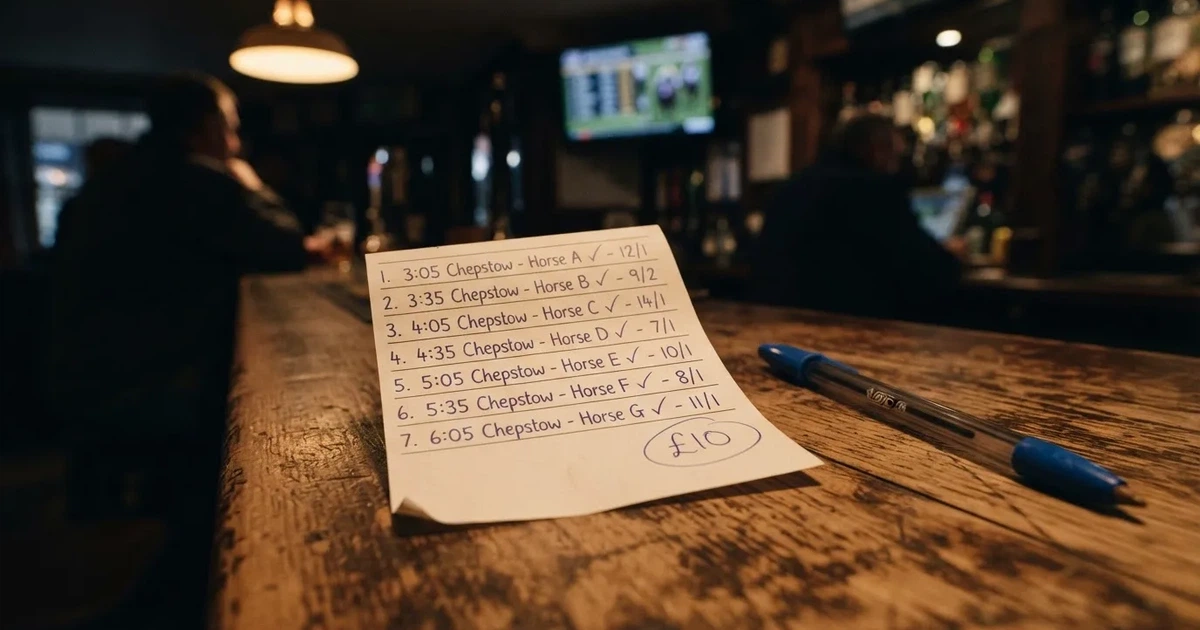
Data current as of 30 October 2026, cross-checked against the Gambling Commission’s public register.
What a Super Heinz actually is
The definition is mechanical. Take seven selections. Form every possible combination of two or more of them. That is the whole of a Super Heinz: every line that can be made from seven picks without dipping into singles. The bookmaker’s bet-type page lays it out as a single named wager; the customer chooses the stake per line, and the total stake is 120 times that figure. At £1 a line, the bet costs £120 before a ball is kicked.

A Super Heinz is one rung up from a Heinz and one rung down from a Goliath. A Heinz covers six selections and contains 57 bets — 15 doubles, 20 trebles, 15 four-folds, 6 five-folds and a single six-fold. A Goliath covers eight selections and contains 247 bets — 28 doubles, 56 trebles, 70 four-folds, 56 five-folds, 28 six-folds, 8 seven-folds and a single eight-fold. The naming convention is loose; “Heinz” alludes to the “57 varieties” slogan, “Super Heinz” and “Goliath” extend the same arithmetic. The key point is that a Super Heinz sits between the two: more lines than a Heinz can offer, fewer than a Goliath’s sprawl, and never any singles.
Because every line is a multiple, the bet cannot produce a partial return from a single winner — the only lines that pay are those where two or more picks land. If only one of the seven selections wins, the whole bet settles as a loss on every line; the stake is gone and there is no consolation. The trade for that exposure is the upside on the longest lines. The single seven-fold, if all seven win, returns the seven-fold multiplied odds at the chosen stake. The trebles and four-folds pay smaller amounts but more often, and the doubles keep the bet ticking over when three or four of the seven lose.
How the bet is settled when something goes wrong
A Super Heinz is a series of independent multiples sharing the same seven picks, so each line settles on its own merits using the selections that ran. Where one pick is void — a non-runner in horse racing, a player who withdrew before a tennis match started — the line drops to the next multiple down: a four-fold becomes a treble, a treble becomes a double, a double becomes a single only if the original line was no higher than a double. The seven-fold, with one pick void, settles as a six-fold on the six remaining selections; a six-fold with a void becomes a five-fold; a double on seven selections does not exist in a Super Heinz, so any double with a void keeps the second pick and is paid as a single at the chosen price. The stake on the affected line is unchanged, and the rest of the bet is unaffected.

Rule 4 deductions — a bookmaker rule that takes a fixed slice off each remaining price when a horse withdraws from a race — apply to the horse-race lines only, not to lines that mix sports. In a Super Heinz that includes only football, cricket and tennis, Rule 4 does not bite; in a Super Heinz that includes a horse race, Rule 4 applies to the horse-race selections and the price on every line that includes them is reduced. The exact deduction depends on the withdrawn horse’s odds at the time of withdrawal and the table the bookmaker publishes. There is no way to factor Rule 4 into the stake before the race; it is settled afterwards, line by line.
In-play and ante-post behaviour is the same as for any multiple. A line settles at the price taken when the bet was placed; if the bet was placed ante-post, the price is the ante-post price; if it was placed in-play, it is the in-play price at the moment of placement. The bookmaker’s site will not let the customer add a selection whose event has already started and then price the new line as if it were ante-post. Where an event is abandoned or postponed and the operator’s rules treat it as void, the same drop-down logic as for a non-runner applies. The bet-type page on each operator’s site states how its own rules handle these cases.
How the stake works — and what the calculator shows
A Super Heinz’s total stake is the unit stake multiplied by 120. A bettor who wants to risk £120 places £1 a line; one who wants to risk £60 places 50p a line; one who wants to risk £1,200 places £10 a line. Each of the 120 lines carries the same stake and settles on its own; the only figure the customer chooses is the unit stake. There is no way to stake different amounts on different lines within a single Super Heinz — that is what distinguishes it from placing 120 separate bets manually, which a bettor can also do on a betting exchange.
The calculator on each operator’s site takes the seven selections, their odds, and the unit stake, and produces a return table: the return on each line that wins, the total return across all winning lines, and the total return if every selection wins. It also shows the total stake and the implied profit if every line wins. The arithmetic is the standard multiple-bet arithmetic: the odds of the legs multiply into one price for each line, and the line’s return is that price times the unit stake. The bet’s overall profit is the total return minus the total stake, and the total stake is paid out only on lines that win.
Worked example with illustrative odds
The calculation uses three illustrative outcomes at odds of 1/2 (1.50), evens (2.00) and 6/4 (2.50). With a unit stake of £2 a line, a Super Heinz costs £240 total. These are standard odds for demonstrating how a full-cover bet scales, as they cover outcomes that are favourites, even money and an underdog choice.
With a seven-fold on these illustrative legs at 1.50, 2.00 and 2.50 across seven picks, the seven-fold price compounds the seven individual prices into one. The seven-fold pays roughly 1.50² × 2.00 × 2.50⁴ × 1.50 ≈ a figure in the low hundreds of decimal odds, which puts the seven-fold return on a £2 line in the low thousands of pounds if all seven selections win. The exact figure depends on which leg carries which price; the band runs from roughly £400 if most legs land at 1.50 to several thousand if most legs land at 2.50, and the point of the worked figure is the band, not one tidy number. A £2 Super Heinz at illustrative prices of this shape returns somewhere in the low four-figure range on the seven-fold alone, plus whatever the six-folds, five-folds and shorter lines add when some but not all selections win.
Two details matter:
- The band comes from this exact set of illustrative odds. A different mix of prices produces a different band; a seven-fold of seven 4/6 shots (1.67) pays far less than a seven-fold that includes a 6/4 leg, and a seven-fold that includes a 10/1 outsider pays far more. The point of the example is the structure, not a price one can take to a betting slip.
- The return above is what a winning bet pays back. It says nothing about how likely the bet is to win. Each leg is an independent judgement of probability, the bookmaker’s margin sits inside every price, and the joint probability of all seven landing is the product of seven single probabilities. A seven-fold that pays 500/1 pays that because, on the book’s reading of form, the seven together are roughly a 500/1 chance — and the bettor’s edge, if any, is whatever separates their reading of those probabilities from the bookmaker’s.
Where the Super Heinz sits in the multiple-bet family
A Super Heinz is a full-cover bet, a class of wager that includes every possible multiple of a given set of selections but not the singles. A Heinz (six selections, 57 bets) and a Goliath (eight selections, 247 bets) are the bookends; a Super Heinz covers seven. The class sits above the part-cover bets — Trixie (3 selections, 4 bets), Patent (3, 7), Yankee (4, 11), Lucky 15 (4, 15), Canadian or Super Yankee (5, 26) — and below the singles-and-multiples bets like the Lucky 31, Lucky 63 and Heinz-with-singles. The defining feature of full-cover bets is the absence of singles; the defining feature of singles-and-multiples bets is their presence.
The smaller multiple-bet structures make sense when the bettor has high confidence in every leg and wants the singles to provide a return even when one pick lets them down. The larger full-cover bets make sense when the bettor wants every combination covered without the singles dragging the return down on the longest lines. The Super Heinz is the choice when the bettor has seven picks they want fully combined and is willing to lose the stake outright if only one lands. The bet’s name — Heinz, Super Heinz, Goliath — is shorthand for that arithmetic and nothing more.
| Multiple | Selections | Lines | Doubles | Trebles | 4-folds | 5-folds | 6-folds | 7-folds | 8-folds |
|---|---|---|---|---|---|---|---|---|---|
| Heinz | 6 | 57 | 15 | 20 | 15 | 6 | 1 | — | — |
| Super Heinz | 7 | 120 | 21 | 35 | 35 | 21 | 7 | 1 | — |
| Goliath | 8 | 247 | 28 | 56 | 70 | 56 | 28 | 8 | 1 |
The table is the shape of the family. A Super Heinz does not include the singles the Lucky 15 and Lucky 31 carry, nor the eight-fold line that the Goliath adds; what it carries is the seven-fold that no smaller full-cover bet has and the 21 doubles that make the bet harder to lose outright than a Goliath at the same unit stake. The trade is mechanical and the bettor chooses it knowingly.
Legality and the Gambling Commission framework
Betting in Great Britain is licensed under the Gambling Act 2005, and the Gambling Commission (UKGC) issues the operating licences that allow an operator to take bets from customers in England, Scotland and Wales. Northern Ireland sits outside the Act and runs its own older regime; a brand’s GB licence does not extend there, and the page speaks “GB-licensed” rather than “UK-licensed” wherever the rule is jurisdiction-specific. Since the Gambling (Licensing and Advertising) Act 2014 the rule is “point of consumption”: any operator whose remote facilities are used in Great Britain needs a Commission licence wherever it is based, so a Gibraltar or Malta registration alone is no longer enough to serve British customers. A Curaçao licence does not authorise a site to take bets from someone in Manchester, and a brand whose only licence is Curaçao is, in British terms, unlicensed.
The Commission’s public register is the whole test of who holds a licence. The register can be searched by business name, trading name, domain or account number, and a brand that does not appear on it has no GB licence — full stop. The licence categories that matter for a Super Heinz are remote general betting standard (real events), which covers fixed-odds sports betting, and remote betting intermediary, which covers betting exchanges. There is no statutory list of permitted markets: an operator holds a licence for a category and offers markets under its own rules and the Licence Conditions and Codes of Practice (LCCP). The Commission does not list “Super Heinz” as a market; it lists the category, and the bet type is the operator’s own product on top of it.
Identity verification is mandatory before the first deposit or bet, including with a free bet or bonus. The Commission’s rules require that name, address and date of birth be checked, and licensed sites do not offer anonymous play. Financial spread betting is regulated by the Financial Conduct Authority, not the Commission, and an FCA-authorised spread betting firm is not licensed by the Commission for fixed-odds betting unless it also holds a Commission licence. The minimum age is 18.
Responsible gambling in Great Britain
Player protection in Great Britain rests on a small stack of interlocking rules. GAMSTOP is the national multi-operator online self-exclusion scheme and a mandatory licence condition for online operators; periods are six months, one year, five years, or five years with auto-renewal, and after the minimum period the exclusion stays in place for a further seven years unless the customer asks GAMSTOP to remove it. GAMSTOP covers online sites and apps; betting shops use a separate service. Every brand in the licensed set takes part in GAMSTOP.
Financial vulnerability checks (LCCP condition 3.4.4) apply to licensed remote betting when a customer’s deposits minus withdrawals exceed £150 in a rolling 30-day window. The check is a public-record check (bankruptcy, county court judgments and the like), not an income check and not a credit reference check, and it kicks in at the £150 threshold. Financial risk assessments — the affordability checks widely discussed in the press — have been announced in a staged plan (Commission article of 7 July 2026), with no start date, so the page says “announced, staged, no start date” rather than “in force”. Deposit limits (RTS 12) require operators to offer a gross deposit limit on a fixed time frame; the first changes have applied since 31 October 2025, a second phase was postponed to 30 September 2026, and whether it is currently live is not established.
There is no state-set deposit or loss ceiling for betting. Limits are the customer’s choice; the operator’s job is to surface them and to act when the customer asks. Help is available through GamCare (which runs the National Gambling Helpline), GambleAware, the NHS gambling clinics network, and Gamblers Anonymous. A Super Heinz with a £10 unit stake costs £1,200 to place in full, and a bettor who has set a £150 weekly deposit limit cannot place the bet in a single transaction at any licensed site — the deposit limit cuts in before the stake does. That is not a marketing caveat. It is the arithmetic.
Bonuses and free bets come with their own wagering cap. Since 19 January 2026, wagering requirements on bonuses are capped at 10x — a £10 bonus at 50x needs £500 of qualifying bets; under the cap no more than £100. The cap applies to free bets whose terms impose a wagering condition; whether it applies to free bets with no wagering condition, and any cap on the money value of a bonus, are not established. Mixed-product promotions — an offer that requires gambling on two or more product types such as betting, casino, bingo and lottery — are banned. The rules concern the offer, not the Super Heinz itself: a Super Heinz placed without a bonus is unaffected.
Bonuses and free bets on a Super Heinz
A free bet is a credit the operator credits to a customer’s account, usually in return for a first deposit or a qualifying bet. The stake is usually not paid back with a win — a £10 free bet at 5/1 returns £50 in winnings and £0 in stake, not £60 — and the offer’s value is the winnings rather than the credit. Wagering requirements, when they apply, multiply the credit by a factor that the operator publishes (a 5x requirement on a £10 free bet means £50 of qualifying bets at the stated minimum price); the 10x cap is the legal ceiling for those requirements on a licensed site.
A Super Heinz paid for with a free bet is a different shape from one paid in cash. Each line is settled against the free-bet credit rather than against the customer’s cash balance, and the stake on the free-bet lines is not returned. A Super Heinz of £1-a-line free-bet credit on seven winners pays the seven-fold’s odds-multiplied winnings on the £1 stake, plus the winnings on every shorter line that lands; the £120 credit has gone out, the £120 is not coming back, and what comes back is the winnings. The size of the free-bet credit matters more than the structure: a £5 free-bet credit a line costs the operator £600 and pays out five times what a £1 credit does on every winning line.
Some bookmakers restrict which multiples a free bet can be used on. QuinnBet, for example, allows free bets on straight accumulators but excludes Trixies, Patents and Yankees; the relevant rule is the operator’s own, published on its help pages, and any restriction is read from the help page rather than guessed at. Free bets expire — QuinnBet’s run for seven days from credit, with minimum odds of 1/2 (1.50) and a maximum of 50/1 — and an expired free-bet credit is forfeit. The headline number is the credit; the live number is the credit multiplied by the share of selections that land, minus any stake the bettor chose to add in cash. The arithmetic is not kind, and the page’s view is that a free bet paid into a Super Heinz is best understood as a discount on the bet, not as a route to a payout.
Advertising and bonuses are policed through the CAP Code (non-broadcast) and the BCAP Code (broadcast), enforced by the Advertising Standards Authority, alongside the LCCP. The “whistle-to-whistle” rule — no betting ads on TV from five minutes before a live sporting event to five minutes after it, before the 9pm watershed, with horse and greyhound racing excluded — is an industry code, not law, and came into force on 1 August 2019. Promo codes are not reproduced here. The page describes what an offer is worth, not how it is claimed.
Strategy, predictions and the reality of a Super Heinz
A Super Heinz does not come with a “system” that wins. The bet is a structure for placing 120 wagers at once, and the structure’s edge — if any — is whatever separates the bettor’s reading of each leg’s probability from the bookmaker’s. The bookmaker’s margin sits inside every leg of every line; on a typical football match the margin on the 1X2 market runs around five to eight per cent of the stake, and the margin compounds across the seven legs of any multiple. A Super Heinz that pays 500/1 pays that because, on the book’s reading of the seven legs, the joint probability is roughly 1/501; the bettor is betting that their joint reading is higher than the book’s.
The mistake to avoid is the same mistake on every multiple: the belief that a longer multiple is automatically a better bet because it pays more. A seven-fold at 500/1 is a worse wager than an each-way single at 5/1 if the seven-fold’s true probability is 1/600 and the single’s true probability is 1/6. The favourite, in betting as in anything, is the bet whose payout share times probability of winning is highest. The Super Heinz’s structure adds nothing to that calculation; it is a way to spread stake across many combinations of the same seven picks, and the question of whether to place it is the question of whether the seven picks, jointly, are worth backing at the prices on offer.
Bankroll management is the practical consideration. A £1-a-line Super Heinz costs £120 before the first leg kicks off, and a £10-a-line Super Heinz costs £1,200. The bettor who is comfortable with a £120 wager and a £1,200 wager are different bettors, and the bet’s design does not adapt to either: the unit stake is the bettor’s choice, and the total stake is 120 times that choice. The licensed bookmakers in the comparison below all publish a free-bet-style calculator that shows the return table, and the same calculator shows the total outlay. Running the calculator before placing the bet is the simplest check, and the bet’s cost is the figure to look at first.
In-play coverage is an operator-by-operator matter. Some bookmakers suspend all multiples containing a match whose score is changing rapidly; others keep the multiples open at adjusted prices. A Super Heinz placed at 14:00 on a Saturday may have one leg suspended at 15:30 because a match has gone in-play and the book has paused pricing on that leg. The line’s stake is unchanged; the price is updated; the bettor has the choice to accept the new price or, on some sites, to remove the affected selection and let the bet recalculate. The experience is the operator’s design, not a regulatory rule, and the experience varies.
The top ten GB-licensed bookmakers offering Super Heinz-style multiples
The following ten operators are listed on the Gambling Commission’s public register against a remote betting licence, and each one offers full-cover multiples — Heinz, Super Heinz, Goliath — as part of its sports product. The list is a comparison of what each licence, betting slip and terms page state; it is not a recommendation, and a place in the list does not guarantee an offer. Several of these brands run under one licensee — Ladbrokes and Coral, Paddy Power and Betfair — and are therefore not independent operators even where their apps and front-ends are separate. Each entry below names the operator, the licence, and the angle the operator brings to the comparison.
Ladbrokes — the established high-street name with a remote licence
Ladbrokes runs on the Commission’s public register under account 54743, with categories including remote general betting standard (real events) and remote betting intermediary; the licence holder is LC International Limited. The site offers odds boosts on horse and greyhound bets, Best Odds Guaranteed on UK and Irish horse races, in-play betting and Acca Boosts, all of which sit on top of a multiple-bet product that includes Heinz, Super Heinz and Goliath. The Acca Boosts lift the price on chosen accumulators but apply to four-fold-plus combinations, not to the doubles and trebles that make up most of a Super Heinz. Ladbrokes provides a reliable, widely recognised high-street brand for those placing a full-cover multiple.
BetMGM — the international brand with a LeoVegas-issued UK licence
BetMGM’s UK app is published by LeoVegas Gaming PLC, and the Commission’s public register lists account 39198 for the remote general betting standard (real events) licence. The site’s sports welcome offer for new UK customers who deposit £10 or more and place a sports bet within seven days is four £10 free bets (two football accumulators of four-or-more selections and two sports multiples of two-or-more), valid for seven days with minimum odds and opt-in required; the offer’s headline number is £40 of free bets, and the operator’s own terms govern the wagering. The full multiple-bet product sits behind the welcome offer, and the bettor who plans to use free bets on a Super Heinz reads the offer’s terms first. The angle is the international brand with a UK app, the LeoVegas-issued licence, and a welcome structure that hands out £40 of free bets in return for a £10 qualifying wager.
NetBet — the price-boost and bet-builder brand
NetBet’s UK remote licence is account 39170 on the Commission’s register, held by NetBet Enterprises Limited. The site’s offer runs Daily Boosts, Profit Boosts and free bet offers on top of a Bet Builder with instant dynamic odds and a stats panel for major leagues. The Profit Boosts are the relevant feature for a Super Heinz: they raise the price on chosen multiples, and the operator publishes which multiples qualify. The Daily Boosts are single-match price lifts that do not affect a multi-match Super Heinz unless one of the boosted selections appears as a leg. The NetBet approach prioritises stats integration and odds boosts for the customer looking to build a multi-leg wager.
Fitzwilliam Sports — the Oddschecker-priced brand
Fitzwilliam Sports’ UK licence is account 48760 on the register, held by SBKI Limited. The site’s distinctive feature is that its prices are based on Oddschecker’s average price for each selection, which gives a customer one way to check whether a price is competitive. The site provides Apple and Google mobile apps, and the bet slip supports Heinz, Super Heinz and Goliath. This operator is well-suited for punters who prefer a transparent market price derived from a comparison service.
Fitzdares — the premium betting brand with ante-post and specials
Fitzdares’ UK licence is account 400 on the register, held by Fitzdares Limited. The app offers cash out, accumulators, Lucky 15s, specials and antepost markets on horse racing, football, tennis, rugby, golf and American football, with in-play live odds. The ante-post book is the distinctive feature: a customer can place a Super Heinz on ante-post horse racing months before a festival and the bet settles on the day. The specials are price lifts on chosen markets, and the Lucky 15s sit alongside the full-cover multiples. Fitzdares caters to the premium racing enthusiast who requires markets open well in advance of the event.
Kwiff — the “supercharged” odds brand
Kwiff’s UK licence is account 44448 on the register, held by Eaton Gate Gaming Limited. The Supercharge feature can instantly boost the odds on a bet — for example from 2/1 to 20/1 — and it can apply to single or multi bets on any sport. The boost is randomised at placement and is the operator’s marketing hook; the underlying multiple-bet product is the standard Heinz, Super Heinz and Goliath. The fit is for the bettor who is happy to take a randomised boost at placement and wants a fresh price on every leg, and the angle is the supercharged odds with a remote licence. The 17+ App Store age rating is the operator’s own classification.
Octobet — the Best Odds Guaranteed brand on UK and Irish racing
Octobet’s UK licence is account 62545 on the register, held by Octopus Game Limited. The site offers Best Odds Guaranteed on UK and Irish horse racing, up to £150 per customer per race. The cap on the BOG is the relevant figure: a Super Heinz that includes a UK or Irish horse race pays out at the higher of the price taken and the starting price, but only up to £150 per race per customer. The cap is the operator’s and applies to the BOG rather than to the multiple itself. For those who include racing legs in their multiples, the BOG feature is a core reason for consideration here.
Matchbook — the betting exchange with a Super Heinz-style product
Matchbook’s UK licence is account 39504 on the register, held by Triplebet Limited, and the licence categories include remote betting intermediary. A betting exchange is a different shape from a fixed-odds bookmaker: customers back and lay against each other rather than against the operator, the operator takes a commission on net winnings, and the prices are set by the customers’ orders. The product list includes a Bet Builder, multiples, in-play betting and live streaming of horse racing and greyhounds. A Super Heinz-style bet on an exchange is a series of lay or back multiples at customer-set prices, and the margin is the exchange’s commission rather than the bookmaker’s overround. This platform functions as an option for those seeking a commission-based exchange rather than a traditional bookmaker book.
Betfred — the high-street chain with a remote product
Betfred’s UK licence is account 39544 on the register, held by Petfre (Gibraltar) Limited. The app offers Bet Builder, Sub Switch, Racing Post data, Extra Places, live casino and bingo, all on top of the standard multiple-bet product. The Racing Post data is the distinctive feature for racing legs: a Super Heinz that includes a horse race can be checked against the form before placement. The Extra Places extend each-way terms on chosen races and apply to singles rather than to multiples. This is a solid choice for the punter who values Racing Post data directly within their betting app.
QuinnBet — the multiple-restricted free bet brand
QuinnBet’s UK licence is account 61011 on the register, held by QuinnBet (Gibraltar) Limited. The free bets credited by QuinnBet are valid for seven days from credit, can be used on any market at odds of 1/2 (1.50) or greater, with maximum odds of 50/1; straight accumulators are allowed but Trixies, Patents and Yankees are not. A Super Heinz, however, is not on the excluded list: it is built from doubles and larger multiples rather than from the named bets that the rule excludes, and QuinnBet’s terms state that straight accumulators are allowed. The fit is for the bettor who plans to use free-bet credit on a Super Heinz and accepts the seven-day expiry, the minimum odds of 1/2 and the maximum odds of 50/1, and the angle is the multiple-permitting free bet with a remote licence. The cap on free-bet wins is the figure that determines the offer’s real value.
Side-by-side: licences and the multiple-bet angle
| Operator | Gambling Commission remote licence | Licence-holder |
|---|---|---|
| Ladbrokes | 54743 | LC International Limited |
| BetMGM | 39198 | LeoVegas Gaming PLC |
| NetBet | 39170 | NetBet Enterprises Limited |
| Fitzwilliam Sports | 48760 | SBKI Limited |
| Fitzdares | 400 | Fitzdares Limited |
| Kwiff | 44448 | Eaton Gate Gaming Limited |
| Octobet | 62545 | Octopus Game Limited |
| Matchbook | 39504 | Triplebet Limited |
| Betfred | 39544 | Petfre (Gibraltar) Limited |
| QuinnBet | 61011 | QuinnBet (Gibraltar) Limited |
Each licence can be checked on the Commission’s public register, which is the whole test of whether a brand holds one. A licence number that does not appear on the register against the named holder is not a GB licence, whatever the operator’s site claims. Several of these brands run under one licensee — Ladbrokes and Coral, Paddy Power and Betfair — and are not independent operators even where the apps are separate. The matchbook licence covers both general betting standard and betting intermediary, so the exchange product and the fixed-odds product both sit on one licence; the others are fixed-odds only. The Super Heinz itself is offered by all ten; the differences are the price features on top of it (odds boosts, supercharge, BOG) and the licence shape behind the brand.
How to place a Super Heinz in practice
The mechanics of placing a Super Heinz are the same at every GB-licensed bookmaker with the bet type in its product. The bettor selects seven outcomes — match result, both teams to score, over/under, set winner in tennis, or any market the bookmaker offers. The bet slip identifies a Super Heinz as one of the named bet types and shows the 120 lines, the unit stake box, the total stake box, the return table if every selection wins, and the implied profit. The bettor confirms and the bet is placed. None of the lines can be edited individually afterwards; the bet is one wager of 120 lines, and any change to a selection changes every line that contains it. The bookmaker’s site will not let the customer combine the seven selections as seven singles plus a Super Heinz (that would be a Lucky 127, a different structure) without the customer explicitly asking.
The minimum stake varies by bookmaker. A £1-a-line minimum is standard at the larger operators; some set a higher floor. The maximum stake is the bookmaker’s call and depends on the customer’s history and the market’s liquidity. The bettor’s deposit limit — the gross limit on deposits in a fixed time frame that the operator offers — sits above the stake; a £1,200 Super Heinz at one go requires a deposit of at least £1,200 above the bettor’s existing balance, and the deposit limit is what stops that at a GB-licensed site when the bettor has set one. None of this is automatic; it is what the operator’s site does when the bettor reaches the relevant page.
Cash-out is offered on some bookmakers’ Super Heinz bets once the bet is in play, and the cash-out value is the operator’s live estimate of what the bet is worth at that moment. Cash-out is a feature, not a rule, and the value on offer reflects the operator’s view of the remaining selections’ probability of landing. A bettor who wants to lock in a partial return rather than wait for the last leg can take the cash-out; a bettor who thinks the operator is undervaluing the bet can leave it to settle. The cash-out value is not the cash equivalent of the bet’s payout, and the difference is the operator’s margin on the cash-out itself.
What the odds are really telling you — and the margin inside them
Every price a bookmaker offers carries the bookmaker’s margin. The margin is the share of every pound bet on a market that the bookmaker keeps, on average, across all outcomes; a market with a 5% margin returns 95% of the stake across all outcomes in the long run, and a market with an 8% margin returns 92%. The margin is built into the prices: a 1X2 market on a football match with three outcomes, each priced at 10/11 (1.91), has a margin of roughly 5%, and the same market priced at 8/11 (1.73) for the favourite, 5/2 (3.50) for the draw and 9/2 (5.50) for the outsider has a higher margin. The bookmaker is not offering fair odds; the bookmaker is offering odds that, across all outcomes, return less than the stake.
The margin compounds across the legs of a multiple. A Super Heinz whose seven legs each carry a 5% margin has an effective margin well above 5% on the longer lines, because each leg’s margin multiplies into the next. The seven-fold price reflects seven individual margins, and the bettor’s edge — if any — is whatever separates their joint probability from the book’s. The bookmaker’s site does not print the margin on every leg, but the margin can be calculated from the prices on each match’s market by summing the implied probabilities of every outcome. A two-outcome market at 10/11 and 10/11 (each outcome at implied probability 1.91 ÷ 2 = 52.4%) sums to 104.8%, and the margin is the excess over 100%, which is 4.8%.
A betting exchange like Matchbook does not embed an overround in its prices the same way a bookmaker does. Customers set the back and lay prices, and the exchange takes a commission on net winnings (typically 2% to 5% on sports). The effective margin is the commission rather than the overround, and the prices on the exchange tend to be sharper than on the bookmaker’s site. The trade is the operator’s credit risk: an exchange pays out only when enough customers have backed the other side, and a customer who places a lay bet at a price no one backs has an unmatched bet rather than a placed bet.
Tax, payments and the rest of the GB-licensed experience
The bettor pays no tax on betting winnings in Great Britain (general information, not tax advice; a professional gambler should ask HMRC or a tax adviser). General Betting Duty is the operator’s tax on gross profits, currently 15%; from 1 April 2027 a new remote betting rate of 25% applies within it, while remote bets on UK horse racing, bets on self-self-service betting terminals in licensed premises, pool betting and in-person betting stay at 15%. The remote rate stays at 15% until 1 April 2027. The Commission’s statutory levy is a separate charge, not a tax, and is the operator’s cost. None of these is the bettor’s cost, and the price on the betting slip is the price paid.
Credit cards are banned for gambling in Great Britain (since 14 April 2020), including credit-card-funded payments through an e-wallet. Debit cards and bank-based payments are not covered by that ban. Identity verification before the first deposit means no anonymous play at a licensed site, and source-of-funds questions at higher spend are normal under the money-laundering rules. Cryptocurrency deposits at licensed operators are not established as a category: some operators accept them, some do not, and the position varies by site. The bettor reads the operator’s terms page for the payment methods it actually accepts.
The bettor’s complaint route is the operator first, then an approved alternative dispute resolution (ADR) body if the operator’s response is unsatisfactory, and then the Gambling Commission if the ADR route fails. An offshore operator offers no Commission complaints route and no approved ADR, and a bettor whose funds are withheld by an offshore operator has fewer practical options. The page says “loss of protection”, not “illegal to use”: betting on an unlicensed site is not an offence in the customer, and the bet is not void; the loss is the absence of the British redress route. The Commission’s enforcement powers are disruption-based — cease-and-desist notices, search-engine referrals, work with registrars, hosts and payment providers — and ISP blocking has been announced as a future power, not as something in operation.
Frequently asked questions about the Super Heinz
What is a Super Heinz bet?
A Super Heinz is a full-cover bet on seven selections consisting of 120 bets, with no singles included. The total stake is 120 times the unit stake the bettor chooses, and the bet settles line by line against the selections that ran. A Super Heinz pays nothing if only one of the seven selections wins, because every line requires at least two winners.
What is a Heinz bet?
A Heinz is a full-cover bet on six selections consisting of 57 bets: 15 doubles, 20 trebles, 15 four-folds, 6 five-folds and one six-fold, again with no singles included. The name alludes to the “57 varieties” slogan; the arithmetic is fixed. A Heinz is one rung below the Super Heinz in the full-cover family and one rung above the Canadian (five selections, 26 bets).
How many bets in a Super Heinz?
A Super Heinz contains 120 bets, and the bet does not include any singles. The total stake is the unit stake chosen on the slip multiplied by 120; at £1 a line the bet costs £120, at £2 a line the bet costs £240, and so on.
How can a bookmaker’s Gambling Commission licence be checked?
The Gambling Commission’s public register can be searched by business name, trading name, domain or account number, and it is the whole test of whether a brand holds a GB licence. A licence number that does not appear on the register against the named holder is not a GB licence, whatever the operator’s site claims. Several brands can run under one licensee — Ladbrokes and Coral, Paddy Power and Betfair — so a brand name on the register does not mean the brand is independent.
How is the return on a bet worked out from the stake and the odds?
For a single bet, the return is the stake multiplied by the decimal odds, and the net profit is the stake multiplied by the odds minus one. For a multiple, the odds of the legs multiply into one price, and the line’s return is that price multiplied by the unit stake. A Super Heinz’s total return is the sum of every line that wins, and the bet’s profit is the total return minus the total stake of 120 times the unit stake.
What is the bookmaker’s margin and how can it be seen in the odds?
The margin is the share of every pound bet on a market that the bookmaker keeps, on average, across all outcomes. It is built into the prices: a 1X2 market at 10/11 (1.91), 10/11 (1.91) and 10/11 (1.91) sums to an implied probability of roughly 105%, and the excess over 100% is the margin. The margin compounds across the legs of a multiple, and the bettor’s edge, if any, is whatever separates their joint probability from the book’s. A betting exchange charges a commission on net winnings rather than embedding an overround in the prices.
Bet types & in-play – tenniscourttips.com
Content created by the «tenniscourttips.com» team
