
Where and how to bet on curling online in 2026
 Available in US
Last verified against the operator’s own terms on 30 October 2026; cross-checked against the Gambling Commission’s public register for current licence status.

The legal frame for online curling betting in Great Britain
Curling has no dedicated statute. It sits inside the same regime as every other sport a bookmaker wades from: the Gambling Act 2005, administered by the Gambling Commission, with the Gambling (Licensing and Advertising) Act 2014 closing the loop on remote operators. Since 2014, any operator whose remote facilities are used in Great Britain needs a Commission licence wherever it is based. A Curaçao, Maltese or Gibraltar licence is not a substitute for a Great Britain licence; it is a different thing issued by a different body under a different law, and it does not put the operator inside the British framework. That single rule is what separates the brands at the foot of this page from every offshore alternative a search might surface.
Great Britain is England, Scotland and Wales. Northern Ireland runs its own older law and is outside the 2005 Act, so a “GB licence” regulates only Great Britain. The test of who holds one is the Commission’s public register, searchable by business name, trading name, domain or account number. No state list of permitted sports or markets exists: curling is offered or not offered because the operator has chosen to list it, not because a regulator has cleared it. The licence categories that matter for a sports punter are remote general betting standard (real events), the most common; remote general betting standard (virtual events), a separate permission for computer-generated events; remote general betting limited, a narrower permission; remote pool betting; and remote betting intermediary, the permission a betting exchange runs on. Financial spread betting sits with the FCA, not the Commission, and that is why Spreadex’s homepage carries both regulators’ names.

The age floor is 18, and identity checks are not optional. Name, address and date of birth are verified before a customer can deposit or gamble — including with a free bet or bonus — and that has been the position since 7 May 2019. There is no anonymous play at a licensed site, and source-of-funds questions at higher spend are part of the money-laundering rules rather than a discretionary check.
What this means for curling specifically is short. A bookmaker that holds a remote general betting standard (real events) licence may list curling matches; whether it actually does is a product decision. The pages that follow deal with where the listing is real and where it is not.
The Commission’s own checks and limits
Player protection in 2026 is layered. GAMSTOP is the multi-operator online self-exclusion scheme, mandatory for online licensees since 31 March 2020, with periods of six months, one year, five years, or five years with auto-renewal. After the minimum period the exclusion stays in place for a further seven years unless the customer asks GAMSTOP to remove it. The financial vulnerability check applies to licensed remote betting when a customer’s deposits minus withdrawals exceed £150 in a rolling 30 days (in force since 28 February 2025); it is a public-record check, not an income check and not a credit reference check. The financial risk assessments the press calls “affordability checks” are announced in a staged plan, with no start date, so the honest summary is “announced, staged, no start date”. Deposit limits under RTS 12 began their first phase on 31 October 2025, with a second phase postponed to 30 September 2026, and whether that second phase is now live is not established. There is no state-set ceiling on what a customer may stake or lose; the operator sets its own maximum stakes and may restrict a customer.
On bonuses, the 10x cap on wagering requirements and the ban on mixed-product promotions have applied since 19 January 2026. A £10 bonus at 50x wagering would have needed £500 of bets; under the cap no more than £100. An offer that asks a customer to bet on football to release free spins is now off the table. Whether the cap applies to free bets with no wagering condition, and any cap on the money value of a bonus, are not established.
Credit cards, tax and advertising
Credit cards have been banned for gambling in Great Britain since 14 April 2020, including credit-card-funded payments through an e-wallet; debit cards and bank-based payments are not covered. The player pays no tax on betting winnings; General Betting Duty is the operator’s tax on gross profits, currently 15%, rising to a new remote rate of 25% from 1 April 2027 while remote bets on UK horse racing, self-service betting terminal bets, pool betting and in-person betting stay at 15%. Advertising is not licensed by the Commission; it runs through the CAP Code (non-broadcast) and BCAP Code (broadcast), enforced by the ASA, alongside the LCCP marketing conditions. The whistle-to-whistle ban on TV betting ads around live sport before the 9pm watershed has applied since 1 August 2019, with horse and greyhound racing excluded. The Premier League clubs’ voluntary withdrawal of gambling sponsorship from the front of matchday shirts, from 2026/27, is a club decision, not a law.
The offshore alternative, honestly framed
A GB licence is compulsory at the point of consumption. Providing gambling facilities in Great Britain without the licence the Act requires is an offence under section 33, on summary conviction up to 51 weeks’ imprisonment, a fine up to level 5, or both — aimed at the operator, not the customer. There is no British consumer-protection route at an unlicensed site: no GAMSTOP coverage, no Commission complaints route, no approved dispute-resolution body, no British redress if funds are withheld, and no binding by the 10x bonus cap or the £150 vulnerability check. Enforcement is disruption rather than blocking, through cease-and-desist notices, search-engine referrals, and work with registrars, hosts and payment providers. The licensed choice means checks, limits, GAMSTOP and the bonus cap; the offshore choice means none of those and the possible loss of funds. Neither is “the safe choice” by default.
Safer gambling tools and where to find help
Every brand reviewed on this page holds a remote licence from the Gambling Commission and is a GAMSTOP participant. That membership is what makes the national self-exclusion register work at all: a customer who registers with GAMSTOP is barred from every GB-licensed online operator and app for the chosen period, with the seven-year tail that keeps the bar in place after the minimum term ends unless the customer asks GAMSTOP to remove it. Self-exclusion is not the only tool on the page, and the full set is worth knowing because each one addresses a different stage of harm.
Deposit limits are the customer’s own. A licensed operator must offer a gross deposit limit on a fixed time frame under RTS 12, and a punter can set one at any time without going through a vulnerability check. Time-outs are the short-form version: a pause of twenty-four hours, seven days, or any operator-defined window in between, applied immediately. Reality checks are the soft pop-up that interrupts the session at a chosen interval and shows net position. Some operators also offer activity statements on demand, so a customer can see deposits, withdrawals and net position without having to ask.
The financial vulnerability check itself is something a customer encounters rather than sets. Once deposits minus withdrawals cross £150 in a rolling 30 days, the operator runs a public-record check for markers such as bankruptcy or county court judgments. It is not an income check and not a credit reference check; it is a screen for signals in the public record that the customer may already be in trouble. The financial risk assessments that have been widely reported are a different stage, announced in a staged plan with no start date at the time of writing, so the honest summary of them is “announced, not in force”.
Where the customer ends up needing more than a self-set limit, the help lines are real. GamCare runs the National Gambling Helpline. GambleAware funds treatment and publishes guidance. The NHS operates gambling clinics in several regions. Gamblers Anonymous runs peer-support meetings. A punter who has self-excluded through GAMSTOP and wants to discuss returning at the end of the minimum term can talk to GamCare before lifting the exclusion; a punter who is still within the term cannot. The Commission does not run treatment itself; it regulates the operators whose customers may end up needing the help.
What a self-exclusion actually does
Once registered, the exclusion is enforced at the account level: the operator closes the account, returns the balance, and stops marketing. The customer cannot open a new account with the same brand for the duration, and the brand’s GAMSTOP feed means a new account at any other GB-licensed online operator will be refused at the registration stage. The seven-year tail after the minimum period is the part that is easy to miss: an exclusion that ends on a particular date does not vanish on that date, and the customer has to take an active step to be removed from it.
The sport: what is on the curling calendar
Curling’s competitive calendar runs across the winter, with the World Curling Championships as its centre of gravity and the Winter Olympics as its peak. The sport became an official Olympic medal event at the 1998 Winter Olympics, and mixed doubles was first held at the Olympics in 2018, so the modern Olympic programme carries both the traditional four-person team event and the mixed doubles. Outside the Olympics, the men’s and women’s World Championships, the World Mixed Doubles Championship and the World Senior Championships carry the rest of the international schedule, with continental championships and the Grand Slam of Curling filling the gap between them. The domestic calendar in Canada, Scotland, Sweden, Norway, Switzerland, the United States, Japan, China, Korea and Italy rounds out the year.
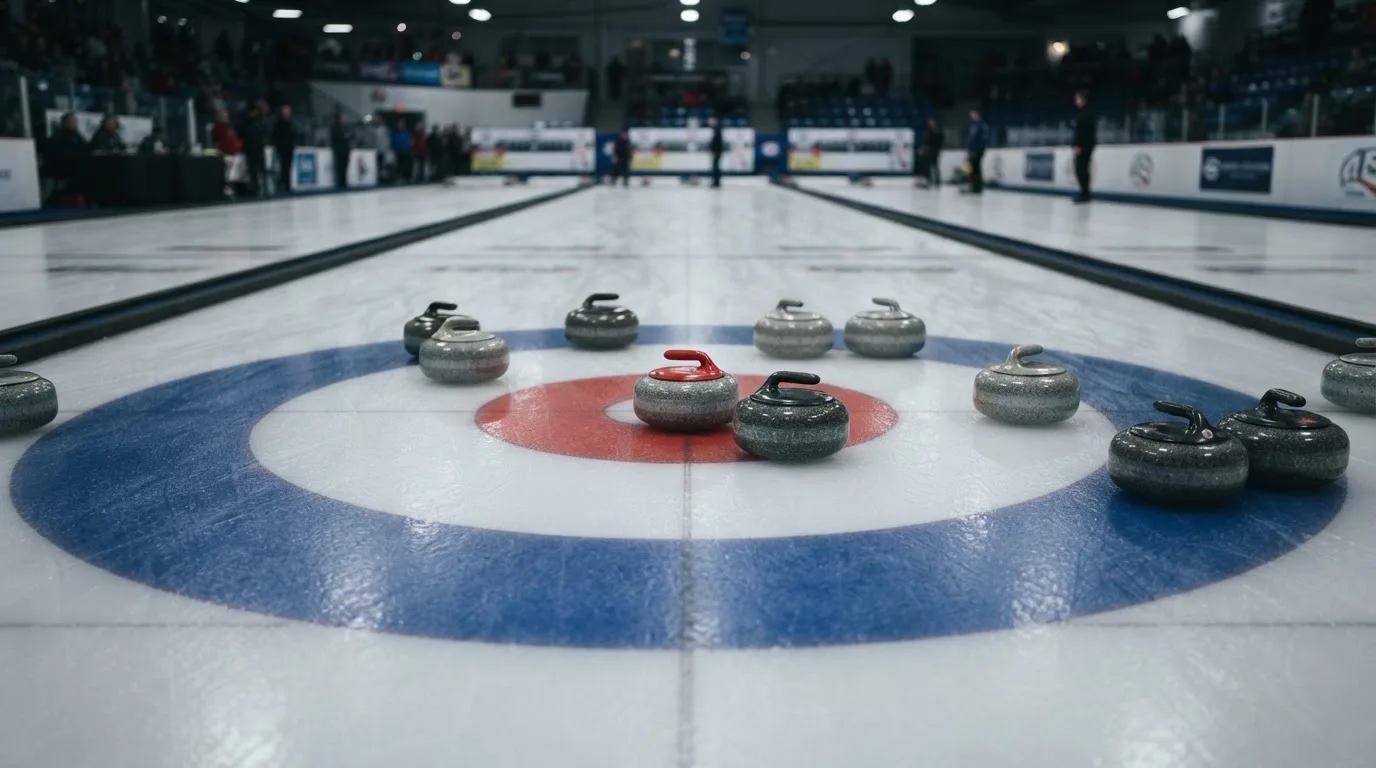
A curling team has four players in the team event, two in the doubles event, and each player throws two of the team’s eight stones per end. Games usually run eight or ten ends; international competitive games are generally ten ends, which is what the World Championships and the Olympics use. After all sixteen stones of an end are thrown, the team with the stone closest to the button scores one point for each of its stones closer to the centre than the opponent’s nearest stone; only stones in the house count, and a blanked end scores zero. The hammer, the last stone of an end, goes to the team that did not score in the previous end; if an end is blanked, the hammer stays with the same team. Tied games go to extra ends, and the hammer is decisive in those ends in a way that makes it the single most tracked variable in the live markets.
Stones weigh between 17.24 and 19.96 kilograms under World Curling Federation rules, which is the answer to the trivia of why the sport has any timing at all. The granite is dense enough that the ice matters as much as the stone, and the pebbling on the ice is what lets the stone curl. A reader who has watched a game and wondered why the same delivery can take two completely different lines is looking at the pebble.
What this means for the markets
A sport whose scoring is one point per stone, only for stones in the house, with hammer as the single tracked variable, is a sport where the live markets are thin. The most common pre-match market is the match winner in two-way form, with a line market on the total points scored over a full game offered by some books. In-play, the markets that actually run are end-by-end winner and total points in the current end, with the match winner suspended and re-priced as the hammer changes hands. The handicap market on stones is offered occasionally. Outrights on the World Championships and the Olympics are listed by the bigger books, and the field prices narrow sharply as the playoffs approach.
The thinner the market, the more the margin matters, and curling markets are no exception. The worked example later in this page shows why a 5% margin and a 10% margin on the same match are not the same bet even at the same odds.
The ten reviewed operators at a glance
The ten operators below are the brands reviewed on this page. Each holds a remote general betting standard (real events) licence from the Gambling Commission and is named on the Commission’s public register; each is a GAMSTOP participant. The licence number, the licence holder named on the register and the position the operator’s own terms take on curling are set out in the table; the individual write-ups below the table work through what that licence and those terms mean in practice. The order is the order on the register rather than a ranking, and no place in this list is itself a recommendation.
| Brand | Gambling Commission remote licence | Licence holder | Position on curling under the operator’s own terms |
|---|---|---|---|
| Fitzdares | 000400-R-103839-030 (account 400) | Fitzdares Limited | listings-only (sources) |
| BetMGM | 039198-R-319450-029 (account 39198) | LeoVegas Gaming PLC | listings-only (sources) |
| Kwiff | 044448-R-323408-017 (account 44448) | Eaton Gate Gaming Limited | listings-only (sources) |
| Lottoland | 038991-R-319408-020 (account 38991) | EU Lotto Limited | listings-only (sources) |
| Midnite | 101839-R-342850-001 (account 101839) | Midnite Limited | listings-only (sources) |
| Octobet | 062545-R-337248-006 (account 62545) | Octopus Game Limited | listings-only (sources) |
| Unibet | 045322-R-324275-019 (account 45322) | Platinum Gaming Limited | listings-only (sources) |
| Fafabet | 057385-R-333191-006 (account 57385) | Taichi Tech Limited | listings-only (sources) |
| Bet600 | 044731-R-323941-016 (account 44731) | Tyche Tech Limited | listings-only (sources) |
| BetGoodwin | 002927-R-327985-008 (account 2927) | Goodwin Racing Limited | listings-only (sources) |
The position on curling is reported only as the operator’s own listings show it; the table does not assert that any of these brands offers curling markets as a standard line, and the reader should check the operator’s own Wettprogramm — its sportsbook catalogue — before staking. Several brands are known primarily for football and horse racing, and the absence of curling from a given brand’s catalogue is not a finding against the brand; it is a finding about the sport’s position on the operator’s product map.
Fitzdares
Fitzdares runs a premium-priced product whose app offers cash out, accumulators, Lucky 15s, specials and antepost markets on horse racing, football, tennis, rugby, cricket, golf and American football, with in-play live odds across the same set. The brand’s licence is held by Fitzdares Limited under Commission account 400, and the platform is positioned as a higher-touch alternative to the high-street names. The product map as the app describes it is silent on curling, and the operator’s terms do not list curling as a standard market. A punter looking for curling here should treat it as a check-the-catalogue situation rather than a default listing.
BetMGM
BetMGM’s UK site is operated under a remote licence held by LeoVegas Gaming PLC under Commission account 39198. The brand’s sports welcome offer for new UK customers who deposit £10 or more and place a sports bet within seven days is a package of four £10 free bets — two football accumulators of four or more selections and two sports multiples of two or more — valid for seven days, with minimum odds and opt-in required. The product depth on football and US sports is the brand’s strength. Market depth here is focused on major US sports and football, so curling does not appear in the standard listings.
Kwiff
Kwiff is operated by Quintiles, a brand marketed around surprise price boosts, and its app carries a 17+ App Store age rating. The licence is held by Eaton Gate Gaming Limited under Commission account 44448. The platform’s product map is weighted towards football and the in-play markets that football supports; curling is not a featured market on the brand’s terms. The surprise-boost mechanic is the brand’s signature, and a punter betting on a niche sport here is betting through that mechanic rather than against it.
Lottoland
Lottoland’s UK app combines casino, lottery betting, sports betting and scratchcards, and it states it is licensed by the Gambling Commission for customers in Great Britain under account 38991, with EU Lotto Limited as the licence holder. Lottery products are the brand’s centre of gravity; the sportsbook is a secondary vertical. The site does not currently list curling markets.
Midnite
Midnite’s site cites Gambling Commission licence 101839, held by Midnite Limited, and the brand’s product shows in-play events, an acca builder, popular accas and price boosts with maximum-stake limits. The brand’s sports welcome offer is a £25 free-bet package plus 50 free spins for new customers who bet £5 or more on pre-match odds of EVS (2.0) or greater within 14 days of sign-up, with the free bets valid for seven days. The product depth on football and esports is the brand’s signature. Curling is not a featured market in the brand’s standard listings, and a punter looking for curling here should treat it as a check-the-catalogue situation.
Octobet
Octobet’s sportsbook is operated by Octopus Game Limited under Commission account 62545. The brand’s sports welcome offer is 50% back as a free bet up to £50, plus a £10 casino bonus for new customers. The product map on football is broad; The sportsbook focuses on popular football markets, and curling matches do not appear in the programme.
Unibet
Unibet states it has operated since 1999, and its UK site is run by Platinum Gaming Limited, Gibraltar, under Commission account 45322. The brand’s sports welcome offer is a £40 free-bet package for new GB customers who deposit and place a sports bet of £20 or more at minimum odds of 2.0 (1/1), with the free bets expiring within seven days of issue and payment by debit card or instant bank transfer required. Unibet’s product depth is broad across European football, tennis and US sports, and the in-play and live-streaming product is one of the deepest in the licensed UK market. Curling is not a featured market on the brand’s terms; a punter looking for it should check the in-play and outright listings around the World Championships and the Olympics.
Fafabet
Fafabet pays Best Odds Guaranteed on UK and Irish horse racing win and each-way bets from 9am on race days: if the starting price is bigger than the original price, the bigger odds are paid. The brand’s licence is held by Taichi Tech Limited under Commission account 57385. The product map is weighted towards football and horse racing. As such, the operator does not include curling in its market coverage.
Bet600
Bet600 pays Best Odds Guaranteed on horse racing: if the starting price is bigger than the early or show price taken, the bet is paid at the SP. The licence is held by Tyche Tech Limited under Commission account 44731. The product map on football and horse racing is the brand’s centre of gravity. Curling markets are not available on this platform.
BetGoodwin
BetGoodwin’s sports welcome offer is a £15 free-bet package in three £5 segments — a £5 sports bet, a £5 acca and a £5 Sub-Cover bet — for new customers staking £10. The licence is held by Goodwin Racing Limited under Commission account 2927, the smallest account number on this list and a marker of a long-established racing-focused book. Curling is not a featured market on the brand’s terms.
How to read curling odds and what the margin costs
Curling’s thin markets make the margin the single number that decides whether a bet is worth taking. The margin is the slice of every pound staked that the bookmaker keeps on average; it is the difference between what you would be paid on a fair market — one where every outcome is priced exactly in proportion to its probability — and what the bookmaker actually offers. On a two-way match-winner market at decimal odds 1.90 and 1.90, the payout share is the reciprocal of the sum of the reciprocals of the two prices: 1 ÷ (1 ÷ 1.90 + 1 ÷ 1.90), which works out to roughly 0.95. That 95% is what a successful punter collectively takes back from this market for every £100 staked across both outcomes; the remaining 5% is the margin.
The same arithmetic at 1.85 and 1.85 gives a payout share of roughly 0.925 and a margin of roughly 7.5%, all else equal. At 1.80 and 1.80 the margin rises to about 10%, and at 2.00 and 2.00 the margin is exactly zero — the only honest quote a bookmaker can give on a two-way market is one where the two prices sum to exactly 2.00 in decimal form, which never happens in real markets because the bookmaker has to earn a margin to stay in business. The honest summary is that on any real curling market the margin is somewhere between roughly 2.5% and roughly 12%, with the lower end at the bigger books on high-profile matches and the higher end at the thinner books on the long-tail events.
That margin is what an “even-money” bet really costs. A punter staking £10 at 1.90 does not have a 50/50 bet; the bet is priced as if each outcome were 52.6% likely, not 50%. The bookmaker’s edge is the gap between those two numbers, and it compounds on every additional leg of an accumulator. A four-fold at 1.90 each leg is priced at 13.03 to one, but the same four outcomes priced individually at fair odds would multiply to a price that is 21% higher than that. The accumulator pays the advertised price; the question is whether the customer knew the price was already marked down before they walked in.
Worked example: the margin on a two-way curling match
Take an illustrative two-way match-winner at decimal odds of 1.90 on each side — an example rather than a quoted price, since the margin on any real curling match depends on the book, the event and the snapshot. The payout share is 1 ÷ (1 ÷ 1.90 + 1 ÷ 1.90) = 0.9474, rounded to 95%. The margin is 1 − 0.9474 = 0.0526, or 5.26% of every pound staked across both outcomes. A punter who backs either side at 1.90 is paying roughly 5p in every pound staked across the market as the cost of having the bet on the board.
This is a statistical estimate, not a guaranteed outcome for any single bettor. The arithmetic is the bookmaker’s expected edge on this market over many bets, and a single winning bet at 1.90 still pays £19 for a £10 stake. What the 5.26% margin does is set the long-run cost of betting on this market at 5.26p per pound staked, and the punter who wants to come out ahead has to find a real edge that beats that number.
What this means for a curling bettor
The margin is higher on curling than on football, because the market is thinner and the books have less competition on price. A bettor who wants to keep the cost of the bet down is keeping the bet on the high-profile events — the World Championships and the Olympics — where more than one book is likely to list the match and the prices are tighter, and is checking the catalogue before staking on the long-tail events where the only available book may be quoting a 12% margin. On outright markets the same logic applies with more force, because the field prices compound the margin across the entire field rather than across two outcomes.
The corollary is that a small-stake bettor on a thin market is paying a higher percentage of the stake as the cost of the bet than a large-stake bettor on a deep market, even at the same odds. The fix is the same fix it has always been: pick the events where the competition is sharp, and check the catalogue before staking.
How to read the bonus offers the operators advertise
Every sports welcome offer on the brands reviewed above follows the same shape: a stake is paid, an additional amount is credited as free bets or bonus funds, and the additional amount carries a wagering requirement, a minimum price and an expiry. The Commission’s 10x cap on wagering requirements applies since 19 January 2026, so no bonus on these brands may now require more than ten times its value in qualifying bets before withdrawal. The brands themselves describe the offers in their own terms; the description here is the shape of what those terms deliver.
Fitzdares’ welcome structure, where one is advertised, runs on the same stake-and-bonus template with the specific terms set out in the brand’s promotional terms. BetMGM’s £10-stake welcome offer delivers four £10 free bets split across football accumulators and sports multiples, with the free bets valid for seven days and minimum odds specified in the promotional terms. Kwiff’s brand mechanic is the surprise price boost rather than a fixed welcome package, and the welcome promotion where one is advertised runs through that mechanic. Lottoland’s sports welcome is structured as a free-bet package with the specific terms in the brand’s promotional terms. Midnite’s £5-stake welcome delivers £25 in free bets plus 50 free spins, with the free bets valid for seven days. Octobet’s sportsbook welcome is 50% back as a free bet up to £50, plus a £10 casino bonus. Unibet’s £20-stake welcome delivers £40 in free bets, with the free bets expiring within seven days and the minimum odds at 2.0 (1/1). Fafabet’s welcome structure runs on the stake-and-bonus template with the specific terms in the brand’s promotional terms. Bet600’s welcome structure runs on the same template. BetGoodwin’s £10-stake welcome delivers a £15 free-bet package in three £5 segments.
The honest reading of every one of these offers is that the free-bet value is the stake multiplied by the odds, minus one, divided by the odds, multiplied by the payout share of the market the free bet is placed on — and that calculation assumes the free-bet stake is not returned with a win, which is the standard mechanic. A free £10 bet at 3.00 with the stake not returned has an average value of £10 × (3.00 − 1) ÷ 3.00 × payout share, where the payout share is set by the market the bet is placed on. On a 95% payout-share market the average value is £6.33; on a 90% payout-share market it is £6.00. The wagering requirement is what then converts that average value into the cost of clearing the offer, because each additional bet at the same margin takes its own slice out of the bank. A punter who treats the free bet as cash is treating it as roughly twice its realisable value; a punter who treats it as a marketing expense is reading it correctly.
The mixed-product promotion ban since 19 January 2026 means no offer on these brands may now require gambling on two or more product types. An offer that asks a customer to bet on football to release free spins is off the table; a promotion that requires a bet on football to release a free football bet is permissible, provided the wagering requirement is at or below 10x. The cap does not apply to free bets with no wagering condition, and the brands reviewed here describe their free bets in those terms where they apply. The honest summary is that the bonus offers on these brands are smaller and cleaner than they were before the cap, and a punter who reads the terms rather than the headline is the punter who actually keeps the value.
How a punter actually clears a welcome offer
The standard sequence is deposit, place the qualifying bet at or above the minimum odds, receive the free bets or bonus funds, place the free bets on markets at or above the minimum odds for the free bet, and let the winnings settle. The wagering requirement, where one applies, multiplies the bonus or the deposit-plus-bonus by the wagering factor to give the required turnover, and the number of bets needed is the required turnover divided by the stake per bet at or above the minimum price. The expected cost of clearing the offer is the required turnover multiplied by the margin of the market the bets are placed on, and that cost is the price the punter is paying for the headline number.
A punter who wants the headline number rather than the cost should not be claiming welcome offers; a punter who wants the value should be reading the terms before claiming. The Commission’s 10x cap is the regulator’s view of where the line is; a brand’s own terms describe how close to that line the offer runs.
Frequently asked questions about online curling betting
How does someone bet on curling online?
Find a bookmaker licensed by the Gambling Commission for Great Britain, complete the identity check, deposit by debit card or bank transfer (credit cards are banned for gambling in Great Britain), navigate to the curling section of the sportsbook, and place a bet on a listed market. The most common market is the two-way match winner; in-play markets include end-by-end winner and total points in the current end, with the match winner suspended and re-priced as the hammer changes hands. Outrights on the World Championships and the Olympics are listed by the bigger books. The catalogue should be checked before staking, because curling is a niche sport and not every brand lists it.
Can someone bet on curling at all?
Yes, at a GB-licensed operator that has chosen to list curling markets. Curling became an official Olympic medal sport at the 1998 Winter Olympics and has been a betting market ever since. The World Curling Championships, the Winter Olympics, the World Mixed Doubles Championship and the Grand Slam of Curling are the events most likely to be listed. The match-winner market is the most common; in-play and outright markets are listed by some books around the bigger events. A punter who cannot find curling at a given brand should check the operator’s own Wettprogramm before assuming the brand is off the table.
How can a punter check that a bookmaker holds a Gambling Commission licence?
Search the Commission’s public register by business name, trading name, domain or account number. The register is the whole test of whether a brand holds a licence; the licence categories listed under the entry tell the punter what kind of betting the brand is licensed for, and the licence holder’s name is the legal entity behind the brand. A Curaçao, Maltese or Gibraltar licence is not a substitute for a GB licence. The domain ending is not proof of the licence: licensed operators use both .com and .co.uk. No brand should be called “the only” licensed one, because the register lists far more brands than any article features.
How is the return on a bet worked out from the stake and the odds?
For a single bet at decimal odds, the return is the stake multiplied by the odds, and the net profit is the stake multiplied by the odds minus one. A £10 stake at 3.00 returns £30, of which £20 is profit; a £10 stake at 1.50 returns £15, of which £5 is profit. For a combination bet the odds of the legs multiply into one price, and the return is the stake multiplied by that combined price. A four-fold at 3.00, 2.50, 1.80 and 1.60 has combined odds of 21.60, so a £10 stake returns £216, of which £206 is profit. The stake is returned on every winning bet at the operator’s terms, and the odds are decimal unless the punter’s slip converts to fractional; the two systems express the same prices and convert by a/b to a ÷ b + 1.
What is the bookmaker’s margin and how does it appear in the odds?
The margin is the slice of every pound staked that the bookmaker keeps on average. On a two-way market at decimal odds of 1.90 and 1.90, the payout share is 1 ÷ (1 ÷ 1.90 + 1 ÷ 1.90), which is 0.9474, or 94.74%, and the margin is the remaining 5.26%. A fair two-way market at 2.00 and 2.00 has a margin of zero, but no real market has a margin of zero because the bookmaker has to earn one to stay in business. The margin compounds on accumulators: a four-fold at 1.90 each leg is priced at 13.03, while the same four outcomes priced individually at fair odds would multiply to a price 21% higher than that. The honest reading is that the margin is the long-run cost of the bet, and a margin of 5% on a deep market and a margin of 12% on a thin one are not the same bet even at the same odds.
How do fractional odds such as 5/1 convert to decimal odds such as 6.00?
The conversion is a/b to a ÷ b + 1. A 5/1 price is 5 ÷ 1 + 1 = 6.00. An 11/4 price is 11 ÷ 4 + 1 = 2.75 + 1 = 3.75. Evens, written as 1/1, converts to 1 ÷ 1 + 1 = 2.00. Odds-on prices (shorter than evens) and odds-against prices (longer than evens) sit on either side of the 2.00 line. The two systems express the same prices and the conversion is mechanical, so a punter who prefers one form can do the maths on a betting slip that displays the other. The stake is returned on every winning bet, and the profit is the stake multiplied by the odds minus one.
Tennis, darts & cue sports – tenniscourttips.com
Content created by the «tenniscourttips.com» team
